

Why Behavior Charts Fail — and What Works Instead
You already know the moment. Your kid melts down at homework time, or during a transition, or when you ask them to put on shoes for the third time. And the behavior chart on the fridge just sits there, its little stickers frozen in place like a scoreboard for a game nobody is winning. You designed it with good intentions. Maybe a therapist suggested it. Maybe a teacher sent one home. But deep in your gut, you’ve felt the disconnect between what the chart is measuring and what your ADHD or autistic child is actually experiencing.
That disconnect isn’t a parenting failure. It’s a design flaw.
The Real Problem With Behavior Charts for ADHD and Autism
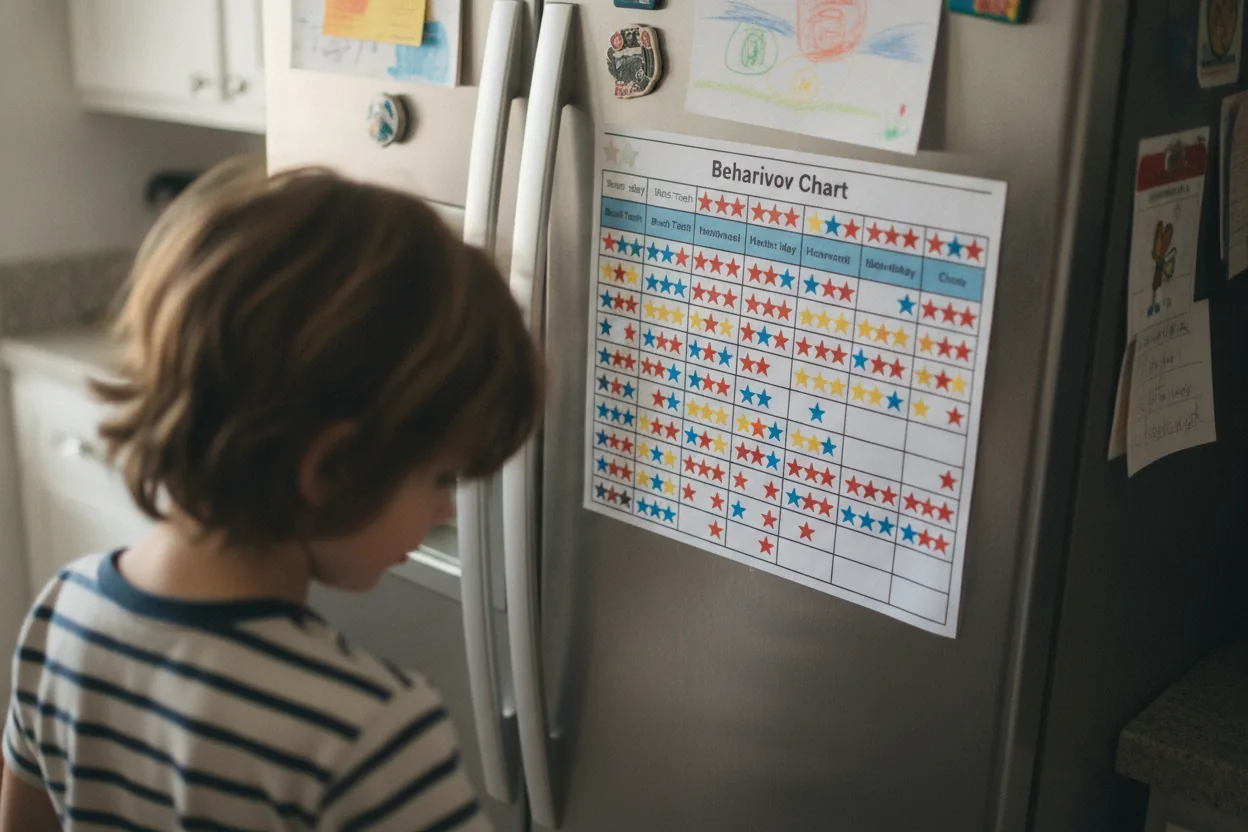
The chart assumes the child can do the desired behavior and just needs the right motivation. Earn enough stickers, get a reward. Lose enough stickers, feel the pinch. It’s a framework borrowed from behaviorism, and for some neurotypical kids in some situations, it can work fine. But for kids with ADHD, autism, or both, the assumption underneath the chart is often wrong.
An ADHD child who can’t sit still during circle time doesn’t lack motivation. Their nervous system is screaming for movement input. An autistic child who refuses to brush their teeth isn’t being defiant. The sensory experience of bristles on gums may be genuinely painful. When we put a sticker chart between the child and these experiences, we’re not addressing the root cause. We’re asking the child to override their neurology for a prize.
And here’s the part that stings a little: they often can, for a while. Kids are remarkably adaptable. An autistic child can learn to suppress a stim. An ADHD child can white-knuckle through a boring task. The chart “works.” Stickers accumulate. Everyone exhales. But what’s actually happening is masking — the process of suppressing authentic neurological responses to appear compliant. Research from the autistic community and from clinical literature increasingly identifies masking as a significant contributor to burnout, anxiety, and mental health crises in neurodivergent people ([Hull et al., 2017, Journal of Autism and Developmental Disorders](https://doi.org/10.1007/s10803-017-3166-5)). The chart didn’t solve the problem. It hid it.
Some autism support materials still use behavior charts as a tracking tool, and there’s a version of that idea worth preserving. Observing patterns, noticing what happens before a meltdown, writing down what you see: that kind of tracking is useful. But tracking to understand is a fundamentally different act than tracking to reward or punish. One helps you see your kid more clearly. The other just keeps score.
What “Nervous-System-First” Actually Means

If behavior charts ask “what’s wrong with this behavior,” nervous-system-first parenting asks a different question: “what’s happening for my child right now?” It sounds subtle, but it changes everything.
The idea is grounded in polyvagal theory, developed by Stephen Porges, which describes how the autonomic nervous system moves between states of safety, mobilization (fight or flight), and shutdown (freeze or collapse). When a child is dysregulated — whether that looks like aggression, withdrawal, rigidity, or a full-body meltdown — they’ve shifted out of a state where learning, cooperation, and flexibility are neurologically possible. No amount of sticker motivation can override that shift. The prefrontal cortex, the part of the brain that handles planning, impulse control, and flexible thinking, goes partially offline during dysregulation. For kids with ADHD, whose prefrontal cortex function is already different at baseline ([Arnsten, 2009, Neuropsychopharmacology](https://doi.org/10.1038/npp.2008.183)), this matters even more.
So what does a parent do instead?
You regulate the environment before you regulate the child. And you regulate yourself before you regulate the environment.
That’s not a platitude. It’s a sequence that works because of biology.
Co-Regulation Is the Strategy, Not the Side Effect

When your child is mid-meltdown and you slow your breathing, drop your voice lower and quieter, and position your body at their level rather than towering above them, you’re not just “staying calm.” You’re providing external cues that help their brain recalibrate toward safety. This is co-regulation, and it is the single most powerful tool in your parenting toolkit for ADHD and autistic kids.
Here’s the mechanism. Mirror neurons and neuroception (the nervous system’s subconscious threat-detection process) mean that your child’s body is constantly reading yours. If your shoulders are up by your ears and your voice has that tight, controlled quality that says “I am holding it together by a thread,” your child’s system registers threat. Not because you’re threatening them, but because your body is broadcasting stress. Their internal state matches it.
The reverse is also true. When you exhale slowly, when your face softens, when you say something like “I’m right here, we’re going to figure this out together,” you’re offering cues of safety. Dr. Mona Delahooke, a pediatric psychologist and author of *Beyond Behaviors*, describes this as the adult being the “calm in the storm” — not through willpower but through intentional physiological regulation that the child can borrow.
A practical example: your eight-year-old with ADHD comes home from school and immediately starts a fight with their sibling. The old playbook says intervene, correct, maybe pull out the chart. The nervous-system-first approach says stop and notice. What was their school day like? Were they holding it together in a fluorescent-lit classroom for seven hours? Are they hungry? Have they moved since recess at 11 a.m.? Their aggression isn’t the problem. It’s the signal.
So instead of “That’s not okay, you’re losing a sticker,” you try: “Hey, your body seems really wound up. Let’s get outside for ten minutes before we do anything else.” You say it while sitting down, not standing over them. You might put a hand on their shoulder if they’re a kid who finds touch grounding, or give them three feet of space if they’re a kid who doesn’t. You know which one because you know your kid.
Sensory Supports Are Prevention, Not Perks

One of the biggest mindset shifts in this approach is moving sensory accommodations from the “earned reward” category to the “baseline need” category. Headphones in a noisy grocery store. A chew necklace during homework. A wobble cushion on their chair. Low lighting in the evening. A five-minute movement break between activities. These are not treats to be dangled on a sticker chart. They are accommodations that change the sensory environment so the child can stay regulated enough to function.
Think of it this way. If your child wore glasses, you wouldn’t make them earn the right to see clearly by completing three tasks without complaint. You’d hand them their glasses in the morning because clear vision is a prerequisite for everything else. Sensory supports work the same way for kids with autism, ADHD, or sensory processing differences. They’re not extras. They’re infrastructure.
[Autism Ontario’s guidance on supporting autistic children](https://www.autismontario.com/) explicitly recommends that adults check whether an intervention is actually helpful and recognize the child as the expert on what they’re feeling physically. This means that if your child says the classroom lights hurt, you don’t need a formal sensory evaluation to take that seriously. You need sunglasses or a hat with a brim or a conversation with the teacher about seating placement.
Building sensory supports into the daily routine also removes the constant negotiation that exhausts everyone. Instead of your child having to ask for a break and risk being told no, the break is already built into the schedule. After 20 minutes of homework, there’s a 5-minute movement break. It’s not a reward. It’s how the afternoon works. The predictability itself is regulating, especially for autistic kids who thrive on knowing what comes next.
Your Regulation Is Part of the Equation
Here’s where it gets personal. If you’re parenting an ADHD or autistic child and you yourself are neurodivergent (which is statistically likely, given the heritability of these profiles), your own sensory load matters. A lot.
The kitchen lights buzzing. The TV blaring from the other room. Your jeans that have been bothering you since noon. The fact that you haven’t eaten since breakfast because you got absorbed in a work project (hello, ADHD). All of this affects your capacity to co-regulate with your child. The neuroscience is specific: a dysregulated adult cannot reliably send cues of safety to a child.
This isn’t about being perfect. That means noticing when your own jaw is clenched before you walk into the room. If you notice that meltdowns escalate faster on days when you’re overstimulated, that’s data. It means your regulation capacity that day was lower, and your child picked up on it. The fix isn’t guilt. The fix is changing your own environment too. Dimmer lights. Comfortable clothes. Eating lunch. Noise-canceling earbuds while you cook dinner. Taking a sixty-second breathing reset in the bathroom before you walk into the room where your child is struggling.
One parent in our community, raising two autistic kids while managing her own sensory processing differences, described it this way: “I stopped thinking of my own needs as selfish and started thinking of them as load-bearing. If I collapse, the whole structure goes.” She started wearing loop earplugs during the after-school chaos window, and within a week, she noticed she was responding to her kids’ dysregulation with curiosity instead of frustration. Nothing about her kids changed. Her capacity did.
How to Start: The “What’s Happening” Audit
If you’re reading this and thinking “okay, I’m convinced, but where do I actually begin,” here’s a concrete starting point. For one week, every time your child has a hard moment, jot down three things: what was happening in the environment (noise, light, people, transitions, demands), what was happening for your child (hungry, tired, overstimulated, understimulated, needing movement), and what was happening in your body (stressed, rushed, sensory overload, calm, fed, rested).
Don’t try to change anything yet. Just notice. You’re building a map. After a week, patterns will emerge. Maybe meltdowns cluster around transitions. Maybe they spike when your child hasn’t had movement in over an hour. Maybe they’re worse on days when you skipped lunch and were running on fumes.
Once you see the patterns, you can start adjusting the environment proactively. Build in transition warnings (“In five minutes, we’re going to switch to bath time. I’ll give you a two-minute warning too.”). Add movement between sedentary activities. Offer a crunchy snack before the hard homework. Put on the noise-canceling headphones before the grocery store, not after the screaming starts.
The key word is before. This approach works because it intervenes upstream of the behavior. By the time a child with ADHD or autism is in full meltdown, the window for teaching, reasoning, or redirecting has closed. Their brain is in survival mode. But if you can catch the early signs of dysregulation and adjust the environment or offer co-regulation at that point, the meltdown often doesn’t need to happen at all.
What You’re Really Teaching When You Ditch the Chart
There’s a fear that comes up when parents move away from behavior charts and consequence-based management. It sounds like this: “But if I don’t hold them accountable, won’t they just do whatever they want? Am I being permissive?”
No. You’re being precise.
Nervous-system-first parenting isn’t permissive. It doesn’t mean there are no expectations or no learning. It means you regulate first and teach second. Once a child is calm, connected, and feeling safe, they can actually absorb what you want to teach them. “Hey, when you threw the book earlier, I think you were really overwhelmed. Next time that feeling comes, what could we try instead?” That conversation, held when everyone is regulated, does more lasting work than any sticker chart ever could.
And the deeper lesson your child is learning isn’t “obey to earn a reward.” It’s “my body gives me signals, and I can learn to read them.” That is a skill that will serve an ADHD or autistic person for the rest of their life. It’s interoception — the ability to notice and interpret internal body states — and it’s something many neurodivergent people need explicit support to develop (Mahler, 2017). Every time you narrate what you see (“Your fists are clenched, I wonder if your body is feeling frustrated”) you’re building that skill.
One Thing to Try This Week
Pick the hardest transition in your day. The one where things fall apart most reliably. For many families, it’s the after-school reentry or the bedtime routine. Now, add one sensory support or environmental adjustment before the transition begins. Maybe it’s ten minutes of outdoor play before homework. Maybe it’s dimming the lights and lowering your voice fifteen minutes before bedtime instead of announcing “time for bed!” from across the house. Maybe it’s offering a chewy snack in the car on the way home from school so your child arrives with a more regulated system.
Try it for five days. Not as a test with a pass-fail outcome, but as an experiment. Notice what shifts. Notice what doesn’t. Adjust. You’re not looking for perfection. You’re looking for fewer moments where your child is pushed past their capacity and more moments where they can actually access the brilliant, funny, creative brain that lives under all that stress.
The behavior chart on the fridge can come down. What goes up in its place is harder to see but more real: a home where the first response to struggle is curiosity, not correction. Where the environment bends toward the child instead of demanding the child bend toward the environment. Where you, the parent, are not the enforcer but the steady ground your kid is learning to trust.
That’s not soft. That’s neuroscience. And it works.