
One Paper Thermometer Won’t Fix It. Here’s What Will.
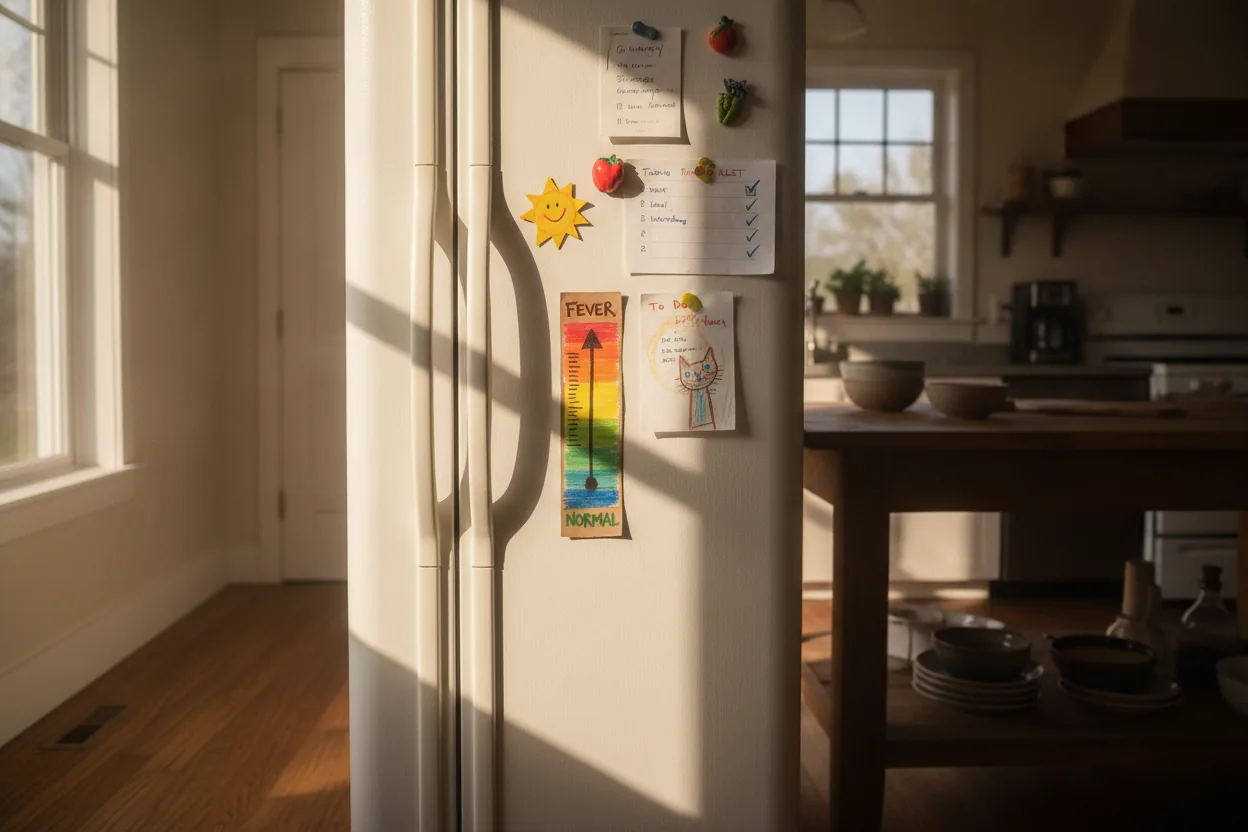
A thermometer taped to the fridge. Not the mercury kind. A paper one, with colors. Green at the bottom, yellow in the middle, red at the top. And the first thing it makes a tired parent feel is skeptical.
Fair enough. You’ve tried the charts. You’ve tried the sticker systems. You’ve watched your kid with ADHD or autism blow past every visual cue you’ve carefully laminated, straight into a full-body meltdown on the kitchen floor. So why would a paper thermometer change anything?
It won’t. Not by itself. But it can become part of something that does, if you understand what strengths-based behavior support actually asks of you. Not more discipline. Not better consequences. Something harder and, honestly, more interesting: teaching your kid to read their own body before it reads them. That’s body cue awareness — and it’s the skill underneath every strategy in this article.
Why Standard Behavior Advice Fails Neurodivergent Kids
Most parenting advice assumes a neurotypical nervous system. It assumes the child can feel frustration building in a linear way, can pause mid-escalation to “make a better choice,” and can respond to verbal redirection while flooded with sensory input or emotion. For kids with ADHD, autism, sensory processing differences, or overlapping profiles, those assumptions don’t hold.
A child with ADHD may have significantly reduced interoceptive awareness, meaning the internal signals that say “I’m getting frustrated” or “my body is tense” arrive late or not at all. Research on interoception and ADHD suggests that difficulty detecting and interpreting bodily signals is a core feature of the profile, not a behavioral failing (Kutscheidt et al., 2019, *Journal of Attention Disorders*). An autistic child may experience the same gap, compounded by alexithymia, a difficulty identifying and describing emotions that occurs in roughly 50% of autistic individuals (Kinnaird et al., 2019, *Molecular Autism*).
So when a well-meaning adult says, “Use your words and tell me how you’re feeling before you get upset,” they’re asking the child to do the very thing their neurology makes hardest. The standard advice says: the child should self-regulate. The child’s neurology says: I don’t have the data yet.
That’s the collision point.
Body Cue Awareness Is a Skill, Not an Instinct

Here’s what actually helps: treating body cue awareness as a teachable skill, not a personality trait. You’re not waiting for your kid to magically “tune in” to their internal state. You’re building that channel, slowly, with external scaffolding.
Start with observation, yours. Before your child can identify their own cues, you need to catalog them. For one kid, a five-year-old melting down every day at school pickup, the early signs might be toe-curling, jaw clenching, a shift to a higher-pitched voice the moment he spots you through the car window. For another, a ten-year-old during the transition between homework and dinner, it’s pacing, humming louder, pulling at the collar of her shirt. These aren’t random. They’re the nervous system broadcasting in a language that predates words.
Write them down. Literally. Keep a short list on your phone for a week. Note what happened before the meltdown, what you saw in their body two to five minutes before the peak, and what sensory or situational demand was present. You’re building a field guide specific to your kid.
Then you name it for them. Not during the meltdown. During a calm moment. “I noticed yesterday that right before things got really hard, your hands were squeezing into fists and your voice got faster. I think your body was trying to tell you something. Let’s figure out what.”
This is where that paper thermometer earns its place on the fridge. Not as a behavior management gimmick, but as a translation tool. Green means “my body feels okay.” Yellow means “something’s building.” Red means “I need help now.” You’re externalizing an internal process so your kid can see it, point to it, and eventually start to feel it from the inside.
Occupational therapists working with sensory processing differences often call this “building the interoceptive curriculum.” [Kelly Mahler’s work on interoception](https://www.kelly-mahler.com/what-is-interoception/), widely used in clinical and school settings, frames body cue awareness as a foundational skill that precedes emotional regulation and adaptive behavior (Mahler, 2019, *The Interoception Curriculum*). You can’t regulate what you can’t detect. And a growing body of clinical evidence supports the idea that explicitly teaching interoceptive awareness improves emotional identification and reduces challenging behavior in autistic children and children with ADHD (Mahler & Craig, 2023, *American Journal of Occupational Therapy*).
Teaching Kids to Ask for Help Before the Crisis

The next step is the one that changes the dynamic: giving your child a way to ask for regulation help before they’re past the point of no return.
This sounds simple. It isn’t. For a child with autism who has limited verbal language, “asking for help” might mean handing you a card, pressing a button on a [communication device](/your-kids-aac-device-belongs-in-the-cafeteria-too), or going to a designated space. For a kid with ADHD who has plenty of language but poor self-monitoring, it might mean learning a single phrase like “I need a break” or “my body’s in yellow.”
The phrase matters less than the response it gets. If a child says “I need a break” and the adult says “not right now, we’re almost done,” the child learns that asking doesn’t work. Next time, they skip the asking and go straight to the meltdown. You’ve just trained them in the opposite direction.
So the deal has to be real. When they use the signal, you honor it. That doesn’t mean the demand disappears forever. It means you pause, reduce input, and help them regulate. Then you return to the task, maybe with support, maybe with a modification. The research on collaborative and proactive solutions, developed by Ross Greene and studied in clinical settings, consistently shows that when children are given workable ways to communicate their struggles, challenging behavior decreases because the behavior was communication in the first place (Greene, 2014, *Lost at School*; Pollastri et al., 2016, *Harvard Review of Psychiatry*).
One family I spoke with described teaching their seven-year-old autistic son a hand signal, palm open, facing out, like a stop sign. It meant “too much.” They practiced during calm times. They role-played it during pretend scenarios. And then, during a noisy family dinner, he used it. He put his hand up, and his mom quietly handed him his noise-canceling headphones. No meltdown. No scene. He ate the rest of his dinner with headphones on and a calmer nervous system. It looked unremarkable from the outside. From the inside, it was months of work arriving in a single gesture.
Micro-Routines Beat Vague Expectations Every Time
“Be good.” “Make good choices.” “Act your age.” These phrases are everywhere in standard parenting language, and they mean almost nothing to a kid whose brain processes information differently.
A child with ADHD has a working memory system that drops instructions like a phone with too many tabs open. A dyslexic child may struggle to process sequential verbal directions. An autistic child may need explicit, concrete information where a neurotypical child infers social expectations from context. Telling any of these kids to “behave” is like handing someone a blank map and asking them to find the restaurant.
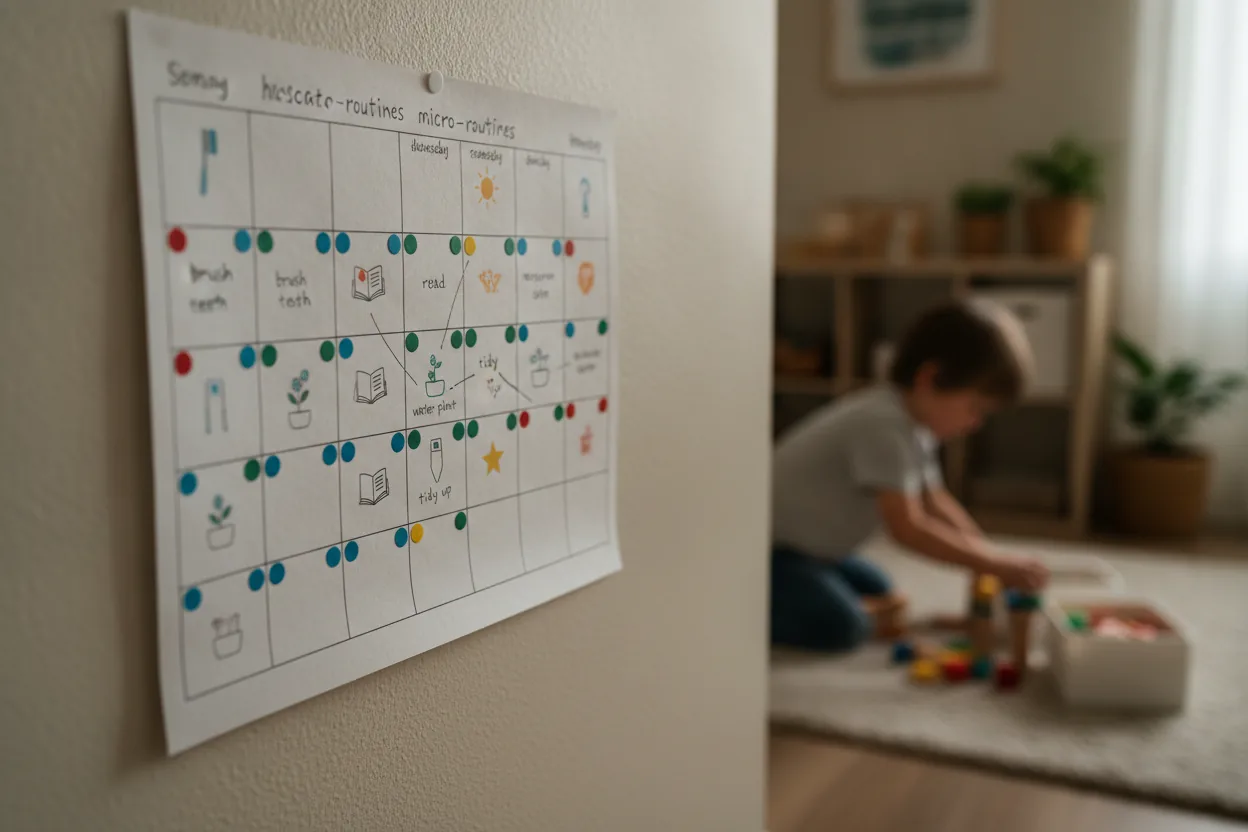
Micro-routines replace the blank map with turn-by-turn directions. They’re short, repeatable, and ideally visible. A morning routine isn’t “get ready for school.” It’s a strip of three pictures on the bathroom mirror: toilet, teeth, shoes. A transition isn’t “we’re leaving soon.” It’s “two more minutes, then shoes, then car.”
The language pattern that works best in clinical and educational settings is “first, then” framing. “First we put on shoes, then we go outside.” It gives the child a visible next step without burying it in a paragraph of verbal instructions. Research on visual supports for autistic children shows that visual schedules and structured routines reduce anxiety, increase independence, and decrease the frequency of challenging behavior (Hume et al., 2014, *Focus on Autism and Other Developmental Disabilities*). The mechanism isn’t magic. It’s predictability. When the nervous system knows what’s coming, it spends less energy bracing for the unknown.
One mother of a nine-year-old with ADHD and sensory processing differences told me she replaced her entire morning verbal routine with a dry-erase checklist on the kitchen wall. Each step had a box her son could check off himself. “I stopped being the nag,” she said. “The list became the nag. And for some reason, he doesn’t hate the list the way he hated me repeating the same five things.”
That tracks. Externalizing the demand removes the interpersonal friction. Your kiddo isn’t refusing you. They’re working through a system. It’s a small difference in framing and an enormous difference in how their nervous system responds to the task.
Co-Regulation Comes Before Self-Regulation
Here’s the part that gets left out of most behavior advice: self-regulation is a developmental achievement that depends first on co-regulation. A child doesn’t learn to calm down by being told to calm down. They learn it by being near a calm adult, repeatedly, over time.
The polyvagal framework, developed by Stephen Porges, describes how the human nervous system uses social cues, especially vocal tone, facial expression, and body posture, to determine whether an environment is safe enough to allow regulation (Porges, 2011, *The Polyvagal Theory*). When a kid is dysregulated, a parent who lowers their voice, slows their body, gets physically low rather than towering, and reduces verbal output is sending the child’s nervous system a signal: you’re safe. You can come down.
This is not a metaphor. It’s physiology. The vagal nerve responds to cues of safety from other humans. A dysregulated child who hears a calm, low voice and sees a still, non-threatening body is receiving neurological input that directly supports a shift out of fight-or-flight.
What this means in practice: when your kid is escalating, your first job is not to fix, teach, or redirect. It’s to get yourself regulated enough to be a co-regulator. That might look like taking three slow breaths before you approach. It might look like sitting on the floor so you’re at their level. It might look like saying absolutely nothing for sixty seconds and just being present and still.
This is devastatingly hard when you’re already exhausted, overstimulated, and running on four hours of sleep. Which brings us to the uncomfortable truth at the center of this whole approach.
Your Regulation Is the First Domino
You can’t lend calm you don’t have. And nobody is asking you to be serene. The goal isn’t inner peace. The goal is [enough steadiness](/you-dont-have-to-be-calm-to-be-a-good-parent) to avoid pouring gasoline on a fire that’s already burning.
Research on parental stress and child behavior outcomes in neurodivergent families shows that elevated parental stress is associated with increased child behavioral difficulties, not because the parent is doing something wrong, but because stress is contagious in a shared nervous system (Neece et al., 2012, *Journal of Intellectual Disability Research*). When the parent’s nervous system is in chronic overdrive, the kid has less access to co-regulation. The cycle feeds itself.
So your regulation matters. Not because you’re the problem. Because you’re the resource. And resources need replenishing.
This doesn’t mean you need a meditation practice or a spa day. It might mean recognizing when your own body is in yellow. Clenched jaw. Held breath. Voice getting tight. You can use the same thermometer your kid uses. Some families do exactly that, and it normalizes the whole process. “I’m in yellow right now. I’m going to take a few breaths and then I’ll be ready to help.”
When your kid sees you name your own state and take a small step to regulate, they’re watching the skill in action. That’s more powerful than any worksheet.
Putting the Pieces Together: One Recommendation
If you’re reading this and thinking “where do I start,” here’s one move that holds all of these pieces together.
Pick one recurring difficult moment in your day. Not the worst one. Not the most public one. A repeatable, predictable moment where things tend to go sideways. Maybe it’s the transition from screen time to dinner. Maybe it’s getting out of the car at school drop-off. Maybe it’s the twenty minutes before bedtime when your kid’s sensory system finally hits the wall.
For that one moment, build a micro-routine with three parts. First, a warning that uses time and sensory language your kiddo can understand: “In two minutes, the iPad goes to sleep. Then we wash hands, then we eat.” Second, a visual or physical cue they can rely on: a timer they can see, a picture sequence, a specific song that plays during the transition. Third, a regulation option available before and during the transition: headphones, a fidget, a squeeze, access to a quiet corner, or simply your calm presence nearby.
Practice it when things are good. Name the body cues you see when things are building. Let your kid know they can signal “yellow” at any point and the response will be support, not punishment. And when it falls apart anyway, because it will, treat the meltdown as data, not failure. What was the demand? What cue did you miss? What adjustment would make next time one degree easier?
Why This Isn’t About Eliminating Meltdowns
This is not a system that eliminates meltdowns. Nothing does. It’s a system that makes meltdowns less necessary, because your kid has language for their body, a predictable structure for the moment, a way to ask for help, and a co-regulator who isn’t adding more noise to an already overwhelming signal.
Body cue awareness doesn’t arrive all at once. For some kids, it takes weeks of you naming what you see before they start noticing it themselves. For others, especially older kids or teens who have spent years being told their reactions are “too much,” there’s a layer of distrust to work through first. They’ve learned to ignore their body because every time it spoke up, someone told them to quiet down.
An eleven-year-old with ADHD and anxiety might not touch the thermometer for a month. That’s fine. It’s still on the fridge. It’s still part of the vocabulary at dinner. And the afternoon she comes home from school, drops her backpack, and says “I think I’m in yellow,” you’ll understand that the skill was building underground the whole time.
That paper thermometer on the fridge won’t fix everything. But it might be the first time your kid has a word for the feeling between fine and falling apart. And that word, small as it is, is the beginning of a skill that will outlast every reward chart and behavior plan you’ve ever tried.