


What Parental Burnout Actually Is (and Isn’t)
She’s standing at the sink rinsing out a lunchbox at 9:47 p.m. The house is finally quiet. Her seven-year-old with ADHD is asleep after an hour-long negotiation about the tag in his pajama shirt. Her ten-year-old, autistic, nonverbal at the end of long days, had a meltdown during homework that rattled every window in the kitchen. She got through all of it. Dinner happened. Meds were given. Teeth were brushed. But she’s crying now, not because anything went especially wrong tonight, but because she can’t remember the last time she felt like herself doing any of it. She used to kneel by the bed and whisper stories. She used to want to. Now she just wants the door to close.
What she’s describing has a name now. Parental burnout.
That isn’t ordinary tiredness. That isn’t a bad week. And the research is finally catching up to what she already knows in her body.
Parental burnout is now recognized in the clinical literature as a specific, measurable syndrome, distinct from general stress, depression, or the low-grade exhaustion every parent carries around like a second wallet. It has four recurring dimensions that researchers have identified across large international samples: emotional exhaustion in the parental role, a painful contrast with the previous parental self, feeling fed up with parenting, and emotional distancing from one’s children [2][4][12]. If you’re raising a kid with ADHD, autism, sensory processing differences, or dyslexia, these dimensions aren’t abstract. They’re Tuesday.
When Tiredness Becomes a Measurable Syndrome

There’s a reason this matters beyond naming it. Stress is broad. Burnout is structural. And the difference changes what you do about it.
Here’s one way to feel it: stress is Tuesday’s meltdown leaving you drained by bedtime, but you bounce back by Wednesday morning. Burnout is realizing you didn’t feel anything during Friday’s meltdown — not anger, not sadness, just nothing — and that scares you more than the meltdown itself. Stress depletes you. This state hollows you out.
Ordinary parenting stress fluctuates. You have a rough morning, you recover over coffee, you show up warmer at pickup. Parental burnout doesn’t reset with a nap or a weekend. It accumulates. Researchers using the Parental Burnout Assessment (PBA), a validated instrument now used across dozens of countries [12], have shown that the syndrome involves chronic depletion specifically tied to the parenting role, not to work, not to marriage, not to finances [2][4]. You might function fine at your job and still be in this state as a parent. That’s part of what makes it so confusing. You can’t be falling apart, you think, because you turned in that quarterly report on time and remembered to buy more melatonin gummies.
But here’s the part that hit me the hardest when I first read the research: one of the four core dimensions isn’t about exhaustion at all. It’s about identity. Specifically, the contrast between who you were as a parent and who you feel you’ve become [2][4][9]. This isn’t a minor mood issue — the literature is clear on that. It’s one of the defining markers of the syndrome. Parents in this state still do the tasks. They still drive to therapy, fill out the IEP paperwork, manage the sensory diet. But they no longer recognize themselves in the doing. The parent who used to get on the floor and build block towers? Gone. The parent who used to delight in the weird, wonderful tangents her ADHD kid took at dinner? Replaced by someone just trying to keep food on the table and voices below a certain decibel.
That loss of self is not a character flaw. It’s a signal. And it deserves to be read that way.
The Contrast With Your Old Self Is Not Nostalgia

I want to sit with this for a minute, because when parents describe it, they often frame it as guilt or nostalgia: “I miss the mom I used to be.” But the research frames it differently. The contrast-with-the-old-self dimension is not about romanticizing earlier parenting. It’s about the lived experience of doing the same role in a body and mind that can no longer sustain the way you once did it [1][2][12]. It’s a functional shift. And it’s painful in a way that’s hard to explain to anyone who hasn’t been inside it.
One mother I spoke with, raising an eight-year-old daughter with autism and significant sensory processing needs, described it like this: “I know what kind of mom I can be because I was her. I was patient. I was creative. I made accommodations feel like adventures. Now I hear my daughter stim and my first internal reaction is dread, not because the stimming bothers me but because I know it means she’s dysregulated and I don’t have anything left to meet it with. And then I hate myself for the dread.”
That sequence — the noticing, the inability to respond the way you once did, the shame — is textbook parental burnout. Not textbook bad parenting. Textbook overload.
Researchers Moïra Mikolajczak and Isabelle Roskam, who developed much of the foundational measurement work on parental burnout, have been explicit about this: the syndrome is a response to chronic imbalance between demands and resources [4][12]. When demands consistently exceed what a parent has available, burnout develops. It’s not mysterious. It’s physics applied to people.
Emotional Distancing: The Part Nobody Wants to Admit

The fourth dimension is the one that scares parents the most, and the one the literature treats as the most clinically significant warning: emotional distancing from children [1][4][12].
This doesn’t mean you stop loving your kids. It means you stop being emotionally present with them. You keep up logistics. You drive, you cook, you manage appointments. But warmth fades. Eye contact drops. You stop initiating affection. You hear your child talking and realize you’ve been nodding without listening for several minutes. Bedtime becomes a thing to survive rather than a place to connect.
For parents raising kids with ADHD, autism, or sensory processing differences, this hits in a particular way because so much of effective support for these kids depends on attunement. The autistic child who needs a co-regulating presence during transitions. The ADHD child who needs someone to notice when focus is slipping and gently redirect without shame. The child with sensory processing differences who needs a parent who can read the early cues of overload before a meltdown becomes inevitable. All of that requires emotional presence. And emotional presence is exactly what this state erodes.
Here’s what makes this tricky: experts note that the combination of exhaustion plus emotional distancing is the pairing that most clearly signals the syndrome rather than simple fatigue [2][4][12]. Exhaustion alone can happen to any parent in a hard season. But exhaustion plus pulling away from your kids emotionally is the alarm. If you’re reading this and recognizing that pattern, please hear this: recognizing it is not a verdict. It’s information. And information you can use.
Why Neurodivergent Family Life Loads the System Differently
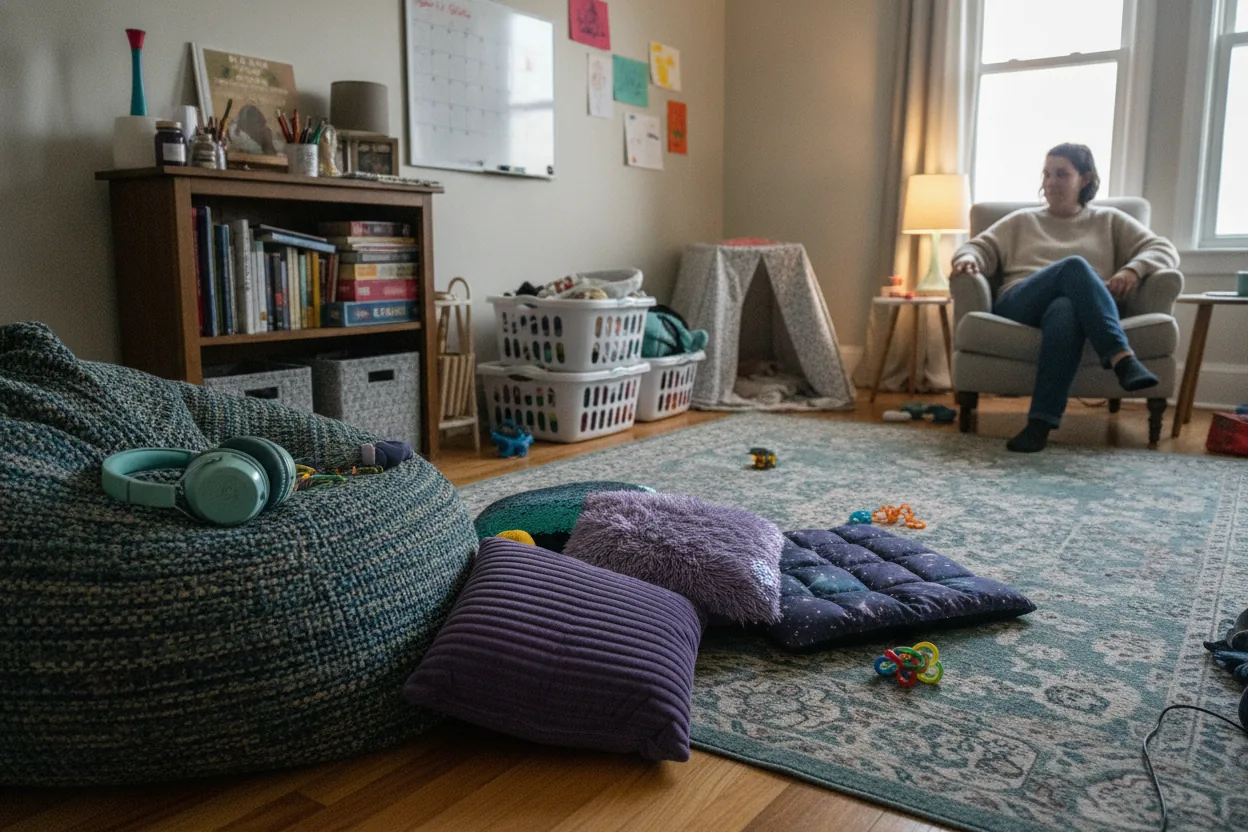
Not all parenting demands are equal, and the research is starting to reflect that. In studies of neurodivergent-parent samples, including parents who themselves have ADHD, autism, or sensory sensitivities, two factors are consistently associated with higher parental exhaustion: the parent’s own sensory sensitivity and lower levels of practical support [6].
Think about what this means on the ground. If you’re a parent with your own sensory processing profile, and your child’s ADHD means the house is loud, unpredictable, and physically chaotic for twelve hours a day, your nervous system is absorbing demands that a neurotypical parent’s system might filter out. The volume of the TV during homework. The scraping of a fork. The constant narration your ADHD child offers because their brain externalizes processing. None of these are problems to be solved. They’re features of your kid’s neurology. But they’re also loads on your nervous system, and if your nervous system is already wired to process sensory input more intensely, that load is measurably higher.
Now add the logistical layer. IEP meetings. Therapy schedules. The insurance call you’ve been putting off for two weeks because the last one took 47 minutes and ended with a denial. The school’s behavioral incident report that uses language like “refused to comply” about your nine-year-old who was in sensory overload. Every one of these is a cognitive and emotional task that lands on top of the regular parenting load.
One finding from the neurodivergent-parent research offers something worth holding onto: emotional distancing may stay lower than exhaustion for some parents in these samples, suggesting that closeness can remain even when capacity is severely strained [6]. In plain language: you might be utterly depleted and still love your kid fiercely, still feel connected to them, still want to be near them. The literature sometimes implies that distancing is inevitable, and for some parents it is. But for others, the bond holds even when everything else is crumbling. That distinction matters. It means your attachment isn’t broken just because your bandwidth is.
How to Spot It Before It Becomes Withdrawal
Parents in this space consistently say they want to know how to catch this earlier. Fair. So here’s what the research and clinical conversation point to as early signals, not in a checklist way but in a “notice what’s shifting” way.
First, pay attention to your internal narrative. If you find yourself regularly thinking some version of “I’m not the parent I used to be” or “I don’t know how much longer I can do this,” that’s not negativity. That’s the contrast dimension surfacing [1][2][9]. It’s data. You’re not being dramatic. You’re registering a real change in your capacity.
Second, watch for what clinicians sometimes call “going through the motions” parenting. You’re still physically present, but your emotional bandwidth has narrowed to near zero. You can get your ADHD child through the morning routine but you can’t muster any warmth while doing it. You can sit next to your autistic child during a hard moment but you’re dissociating rather than co-regulating. The body is there. The person isn’t.
Third, notice decision fatigue compounding. Parental burnout doesn’t just affect patience; it affects the quality of your decisions [4][11][14]. When depletion becomes chronic rather than episodic, your ability to make the judgment calls that neurodivergent parenting requires all day long starts to degrade. Should I push through this homework or let it go? Is this a sensory need or avoidance? Do I call the school about this incident or let it pass? These decisions require a functioning prefrontal cortex, and chronic depletion degrades prefrontal function. You’re not making worse decisions because you care less. You’re making worse decisions because your brain is running on fumes.
What Actually Helps: Load Reduction, Not Willpower
Here’s where the conversation gets practical, and where it departs from the usual advice parents get.
The most effective intervention for parental burnout is not asking the parent to cope better. It’s reducing the load [6][14]. That sounds obvious, but think about how rarely it’s the actual response parents receive. Instead, parents typically hear: take a bath, practice mindfulness, find time for yourself. Those things aren’t useless. But recommending them to a parent whose system is chronically overloaded is like telling someone with a broken leg to stretch more. The structure is compromised. You have to address the structure.
Reducing load looks different for every family, but the research points to a few consistent levers. Predictable routines lower decision fatigue and sensory ambush. If your ADHD child knows what happens after school without having to ask, and you know what happens without having to improvise, that’s fewer micro-decisions draining both of you. Sensory accommodations for the parent, not just the child, matter enormously. If noise is a trigger for your own sensory system, noise-canceling headphones during high-chaos windows aren’t an indulgence. They’re an accommodation. Concrete help from partners, family members, or school systems is the single most consistent buffer against parental exhaustion in the neurodivergent-family literature [6]. Not emotional support, although that helps too, but actual task reduction. Someone else handles the insurance call. Someone else drives to Thursday therapy. Someone else manages dinner on IEP weeks.
One father I spoke with, parenting a child with ADHD and dyslexia, described the shift that changed things for his family: “We sat down and listed every single task that parenting our son requires in a week. Not the fun parts. The logistics. The calls. The reading practice. The medication management. The school communication. When we saw it on paper, my wife and I both understood why she was drowning. She wasn’t weak. The list was impossible for one person.” They redistributed. Not perfectly, not evenly, but deliberately. And within a month, his wife said the contrast feeling, the “I used to be a better mom” feeling, started to soften. Not because she changed. Because the load changed.
Protecting Connection Without Demanding Constant Warmth
One of the most compassionate reframes coming out of the current research is this: the goal isn’t to be emotionally warm at all times. The goal is to preserve connection and functioning [6]. Some parents can stay emotionally attached even while depleted. That attachment is real and it counts. You don’t have to perform warmth to be a loving parent.
For parents of autistic kids, this reframe is particularly meaningful. If your child doesn’t rely on the same affective cues that neurotypical parenting culture prizes, like constant smiling, animated voices, enthusiastic eye contact, then your quieter, steadier presence during a depleted stretch may actually be fine for your child. Not every kid needs you to be “on” in the way the parenting internet implies. What they need is you to be safe, predictable, and real.
The words that help here are simple. Try saying to your child, during a low moment: “I’m tired tonight but I’m right here.” Or: “My brain is full. Can we sit together quietly?” You’re modeling honesty and staying in proximity. For a child with ADHD who reads emotional inconsistency as rejection, that narration is stabilizing. For an autistic child who values predictability over performance, your honesty is a gift.
When It Isn’t Burnout: Knowing the Difference
Parents also want to understand where the line is between parental burnout and depression, and that’s a fair and important question. Parental burnout is role-specific. It centers on the parenting domain. Depression is more pervasive, affecting mood, motivation, and functioning across life contexts [2][12][14]. If you’re struggling at work, in relationships, with basic self-maintenance, and in parenting, that’s more likely a depressive episode and it deserves clinical attention.
But here’s where it gets complicated: parental burnout can trigger depression, and depression can worsen parental burnout. They’re not the same, but they feed each other. If you’re unsure which you’re experiencing, a clinician who understands the burnout construct (not all do, it’s still relatively new in applied settings) can help parse it. The PBA, the Parental Burnout Assessment, is freely available and has been validated in multiple populations [4]. It’s not a diagnostic tool in a clinical sense, but it can help you and a provider have a more specific conversation than “I’m stressed.”
The Reassurance You Came Here For
If you’ve read this far and you’re seeing yourself in these descriptions, I want to say something clearly: you are not failing. You are a parent whose load has exceeded your resources for long enough that your system started protecting itself the only way it knows how — by pulling back. That pulling back isn’t apathy. It isn’t laziness. It isn’t proof that you weren’t cut out for this. It’s a neurobiological response to chronic imbalance, and it has a name, and it’s being studied, and you’re not the only one standing at the sink at 9:47 p.m. wondering where you went.
The parent you used to be didn’t leave because you failed. She left because the load was unsustainable and nobody told you that was a thing that could happen, that had a name, that wasn’t your fault. Now you know. And knowing is the first thing that changes the math.
Start with the load. Not with yourself. The load came first. The load changes first.
You’re still here. That counts more than you think.
—
References:
[1] Mikolajczak, M., & Roskam, I. (2018). A theoretical and clinical framework for parental burnout: The Balance between Risks and Resources (BR²). *Frontiers in Psychology*, 9, 886.
[2] Roskam, I., Raes, M.-E., & Mikolajczak, M. (2017). Exhausted parents: Development and preliminary validation of the Parental Burnout Inventory. *Frontiers in Psychology*, 8, 163.
[4] Mikolajczak, M., Brianda, M. E., Avalosse, H., & Roskam, I. (2018). Consequences of parental burnout: Its specific effect on child neglect and violence. *PLoS ONE*, 13(4), e0196237.
[6] Lutz, A., Keenan, B. M., & Schiltz, H. K. (2024). Parental burnout among neurodivergent parents of autistic children. *Journal of Autism and Developmental Disorders*.
[9] Sánchez-Rodríguez, R., Perier, S., Callahan, S., & Séjourné, N. (2019). Revue de la littérature relative au burnout parental. *Canadian Psychology*, 60(2), 77–89.
[11] Sorkkila, M., & Aunola, K. (2020). Risk factors for parental burnout among Finnish parents: The role of socially prescribed perfectionism. *Journal of Child and Family Studies*, 29, 648–659.
[12] Roskam, I., Aguiar, J., Akgun, E., et al. (2021). Parental burnout around the globe: A 42-country study. *Affective Science*, 2, 58–79.
[14] Mikolajczak, M., Gross, J. J., & Roskam, I. (2019). Parental burnout: What is it, and why does it matter? *Clinical Psychological Science*, 7(6), 1319–1329.