

Strong and Struggling Aren’t Opposites
You already know how to hold two things at once. You know how to sit in a waiting room filling out intake forms while simultaneously texting your partner a grocery list. You know how to celebrate a new skill your child learned while bracing for the next school meeting where someone will catalog everything they can’t do. You’ve been doing this so long that the contradiction stopped feeling like a contradiction. It just feels like Tuesday.
That ability to carry opposing realities at the same time is something researchers have recently started studying in parents of autistic children, and what they’re finding matches what you probably already sense in your own body: you are both more stressed and more resilient than most people around you, and those two facts don’t cancel each other out.
The problem is that most of the support offered to families like yours is built on the assumption that they do.
Why Autism Parent Stress and Toughness Coexist

For a long time, the research literature on parents of autistic kids focused almost entirely on burden. Study after study documented elevated rates of anxiety, depression, and chronic stress. And those findings are real. A 2022 study published in the *Journal of Autism and Developmental Disorders* found that parents of autistic children consistently report higher levels of psychological distress than parents of typically developing children and parents of children with many other disabilities[2]. That gap isn’t small, and it isn’t explained away by personality or attitude.
But more recent work has started asking a different question. Instead of only measuring what’s breaking down, researchers began measuring what’s holding up, and they found something that would surprise no one who’s actually living it: higher resilience scores often sit right alongside higher stress scores in the same parent, in the same household, on the same Tuesday afternoon[2][12].
This isn’t a paradox. It’s a predictable outcome of sustained difficulty met with inadequate structural support. When systems don’t carry the load they should, individual people get stronger because they have to. That strength is genuine. It’s also expensive.
A 2023 review on psychosocial risk and protective factors in parents of autistic children, published in *Research in Autism Spectrum Disorders*, found that resilience isn’t the absence of stress but a parallel process[12]. Parents who scored high on resilience measures didn’t report less stress. They reported being better able to function despite the stress. The distinction matters enormously, because it changes what kind of help makes sense.
[Image placement 1: A parent sitting alone in a car in a parking lot, eyes closed, head back against the headrest. Alt text: An autism parent taking a moment alone in a car — a common scene that illustrates the hidden cost of resilience.]
The Coping Trap: When Advice Replaces Actual Support for Autism Parents

Here’s where things go sideways. When professionals, family members, or even well-meaning friends see a parent who’s managing, the instinct is to praise the coping. “You’re so strong.” “I don’t know how you do it.” “You should try meditation.” The message, however gently delivered, is that the current arrangement is working and the parent just needs a few more internal resources to sustain it.
Picture the parent sitting in her car in the school parking lot after a three-hour IEP meeting, the one where she had to explain, again, why her son needs an aide, with documentation she assembled at midnight. Her phone buzzes. It’s a text from a friend: a link to a stress-relief app and a heart emoji. She stares at it, then puts the phone down and drives to therapy pickup. The app isn’t wrong. It’s just so far from the point that it might as well be on another planet.
Telling a parent who’s already operating at full capacity to add a regulation practice without reducing any demands is like telling someone carrying four bags of groceries to also hold a yoga pose. The suggestion isn’t wrong in isolation. It’s wrong in context.
The research backs this up. Interventions that focus on mindfulness, self-compassion, and psychological flexibility do show measurable benefits for parents of autistic children. Studies reviewed across multiple meta-analyses report reductions in parenting stress and improvements in staying power and self-efficacy when parents engage in these kinds of programs[1][4][7][10]. Those findings are legitimate. But the same body of research reveals a crucial detail that often gets lost: the parents who benefit most from internal regulation tools are the ones who also have external support holding some of the weight[2][12].
In other words, the mindfulness works better when you actually have 20 minutes to do it. The self-compassion practice is more accessible when someone else is watching your kid. The psychological flexibility improves when you’re not also fighting with insurance at 10 p.m.
This is the coping trap. We keep prescribing internal strategies for problems that are at least partially structural.
What Actually Protects Autism Parents’ Mental Health
The 2022 study on resilience and distress in parents of autistic children identified several factors that were consistently linked to lower psychological distress[2]. Some of them are what you’d expect. Some of them are surprisingly specific.
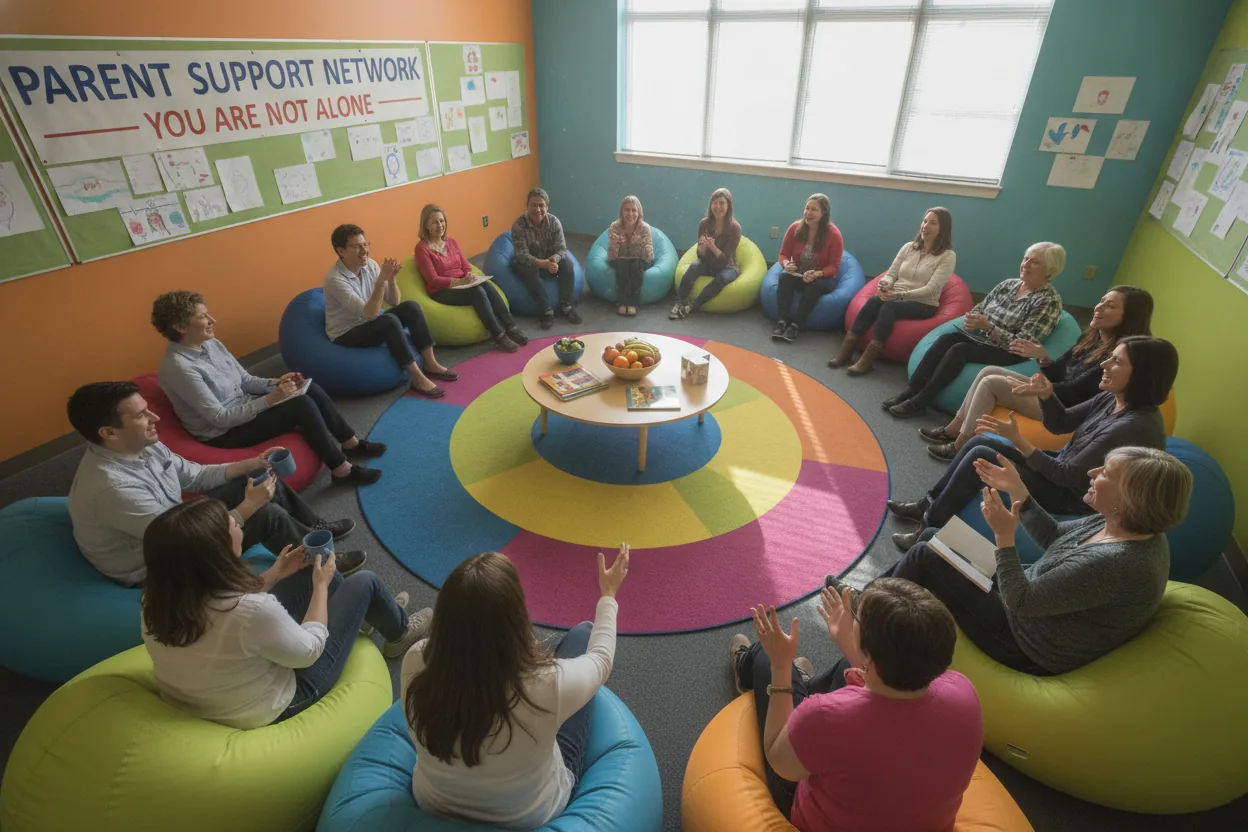
Belonging to a parent association was protective. Not just knowing other parents of autistic kids, but being part of an organized group where people met regularly and shared information. The researchers found that this kind of structured connection predicted lower anxiety and depression even after controlling for other variables[2].
Having at least one trusted person to talk to was protective. Not a therapist, necessarily, though therapy showed benefits too. The study pointed to the presence of a single reliable confidant as a buffer against the worst mental health outcomes[2]. One person who gets it and picks up the phone.
Broader social and contextual support was protective. This meant things like having a partner who shared caregiving responsibilities, living in a community with accessible services, and having a school team that communicated openly rather than adversarially[2][12]. (If you’re navigating school relationships right now, our piece on [what a meaningful IEP actually looks like](link-to-iep-article) gets into the dynamics that make or break those partnerships.)
None of these are internal qualities. They’re conditions. They’re features of a life that either exist or don’t, and their presence or absence shapes whether a parent’s toughness comes at a sustainable cost or an unsustainable one.
The 2023 review added another layer by identifying emotion-regulation ability as a key mediating factor[12]. Parents who could recognize, name, and modulate their own emotional responses showed better mental health outcomes. But the review was careful to note that emotion regulation doesn’t happen in a vacuum. It requires time, cognitive bandwidth, and an environment that doesn’t constantly demand crisis-mode responses. A parent who spends three hours a day managing meltdowns, navigating IEP disputes, and coordinating therapies has less regulatory capacity left over not because they’re weaker, but because the tank is genuinely emptier. (We’ve written more about what’s happening in your body before those crisis moments in our [body-cue field guide](link-to-body-cue-article) — it’s worth a read alongside this one.)
[Image placement 2: A split image — one side showing a parent smiling at a child’s accomplishment, the other showing the same parent with head in hands over paperwork. Alt text: Autism parent resilience means holding both joy and exhaustion, often in the same day.]
The Meaning-Making Question: Growth Without Minimizing

One of the more nuanced findings in the recent literature involves positive meaning-making. Some parents of autistic children report that the experience of raising their child has changed their values, deepened their relationships, or given them a sense of purpose they didn’t have before[12]. Researchers have found that this kind of meaning-making can buffer stress, not by reducing the actual demands, but by changing the internal narrative around them.
This is worth handling carefully, because it can easily slide into toxic positivity. Telling a parent who’s drowning that their struggle is a gift isn’t support. It’s dismissal with a bow on it.
But when meaning-making emerges from the parent’s own experience, on their own timeline, it appears to function differently. The 2023 review distinguished between meaning that’s imposed from outside (“Everything happens for a reason”) and meaning that’s constructed from within (“I understand empathy differently now because of my child”)[12]. The latter showed a genuine protective effect. The former did not.
This has practical implications for anyone supporting these families. Therapists, support group facilitators, and even friends can create space for a parent to find their own meaning without scripting it. The question “What has surprised you about yourself through this?” lands differently than “At least you’ve learned so much.” One invites. The other insists.
What Real Support Looks Like Beyond Individual Coping Skills
If the research is pointing anywhere, it’s toward a model that combines internal skill-building with structural load reduction. Not one or the other. Both.
Concretely, that means respite care that’s actually available, affordable, and staffed by people who understand autism. It means school teams that treat parents as partners rather than obstacles. It means insurance systems that don’t require a parent to spend hours on the phone proving their child needs what everyone already agrees they need. It means employers who understand that a parent leaving early for an occupational therapy appointment isn’t a productivity problem but a family managing a complex reality.
It also means rethinking how we deliver parent-focused interventions. The studies on mindfulness and self-compassion programs show real results, but participation rates and dropout rates tell their own story[1][4][10]. Parents leave these programs when they can’t get childcare, when the sessions are scheduled at impossible times, or when the content feels disconnected from the specific intensity of raising an autistic child. The most effective programs in the literature are the ones that accounted for these barriers by design, offering flexible scheduling, providing childcare during sessions, and incorporating autism-specific content rather than generic stress management[7][10].
Parent-to-parent connection also shows up repeatedly as a factor that professional services alone can’t replicate[2][11]. There’s something that happens between two parents who both know what it’s like to explain stimming to a stranger at the grocery store. That mutual recognition reduces isolation in a way that even excellent therapy sometimes doesn’t. The research doesn’t suggest peer support replaces clinical services. It suggests that peer support does something clinical services can’t, and that both are needed.
What Autism Parent Resilience Actually Costs
Consider two parents. Both have eight-year-old autistic sons. Both score high on measures of how well they’re functioning. Both are, by any external assessment, managing well.
The first parent has a flexible work schedule, a partner who shares appointments equally, a school team that responds to emails within 48 hours, and a monthly autism parent group that meets at the library down the street. Her staying power is real, and the infrastructure around her makes it sustainable.
The second parent works rigid hours, handles all therapy coordination alone, has spent six months in a due-process dispute with the school district, and hasn’t seen a friend in a social context in four months. Her toughness is also real. But it’s costing her sleep, her health, and her marriage.
On paper, these two parents might look the same. Same functioning scores. Same child profile. Same diagnostic category. But the experience in the second parent’s life is fundamentally different because that resilience isn’t free — it’s compensation for support that isn’t there. It’s filling gaps that systems and people should fill. And no amount of breathing exercises will change the fact that she needs another adult to help carry the load.
This is what the research is signaling when it says resilience and stress coexist. It’s not a feel-good finding. It’s a structural diagnosis. These parents are strong. They’re also unsupported. And strength without support has a shelf life.
[Image placement 3: A single parent at a kitchen table surrounded by therapy schedules, school forms, and a laptop open to an insurance portal. Alt text: The hidden workload behind autism parent resilience — coordination, advocacy, and paperwork that rarely gets seen.]
What You Can Actually Do With This Information
If you’re a parent reading this and recognizing yourself, here’s what the evidence suggests is worth your limited time and energy.
Find your one person. The research on having a trusted confidant is striking in its simplicity[2]. You don’t need a large network. You need one person who understands the specific texture of your life and who you can talk to without translating. If you don’t have that person yet, a structured parent group for families of autistic kids is the most reliable way to find them. Online counts. A Facebook group where people actually respond counts. The format matters less than the specificity. A general parenting group won’t do what an autism-specific one does.
Audit where your strength is compensatory. Ask yourself: what am I doing right now that a service, a system, or another person should be doing instead? You may not be able to change it immediately, but naming it breaks the illusion that your current output is baseline normal. It isn’t. You’re overperforming because the infrastructure is underperforming, and recognizing that distinction protects you from the belief that you’re failing when you’re actually exhausted. (If the school side of that equation feels especially heavy, our [504 vs. IEP breakdown](link-to-504-iep-article) can help you figure out whether you’re fighting the right fight.)
If you’re going to invest in a regulation practice, choose one built for your reality. Acceptance and Commitment Therapy, or ACT, has a growing evidence base for parents of autistic children specifically because it targets psychological flexibility rather than symptom suppression[4]. The goal isn’t to feel less stressed. The goal is to act in line with your values even when you’re stressed. That’s a meaningful difference, and parents in these studies report it feels more honest than being told to relax.
Advocate for structural support with the same energy you advocate for your child. Request respite hours through your regional disability services. Ask your child’s therapy provider whether they offer parent coaching as part of the treatment plan, since many evidence-based autism interventions include a parent component that insurers are required to cover. Push back when school teams frame collaboration as a favor rather than a legal obligation.
You’ve been holding both things — the stress and the strength — for a long time. The research confirms what you already know: you’re not imagining either one. What you deserve is a world that stops treating your resilience as proof that you don’t need help, and starts treating it as evidence that help would actually work.
—
*References: [1] Lunsky et al., 2021, mindfulness intervention review. [2] Giannotti et al., 2022, resilience and distress in parents of autistic children, JADD. [4] Fung et al., 2018, ACT for parents of children with ASD. [7] Catalano et al., 2018, parenting self-efficacy interventions review. [10] Hartley et al., 2019, resilience-focused interventions for autism families. [11] Bonis, 2016, peer support among parents of autistic children. [12] Yorke et al., 2023, psychosocial risk and resilience in parents of autistic children.*