
AAC Communication Access Isn’t a Reward to Earn
The speech therapist told Marco’s mom that he could use his AAC tablet during structured therapy sessions but should try to use his words the rest of the day. His mom watched him go silent for six hours straight. AAC communication access shouldn’t be something families have to fight for — but right now, it is.
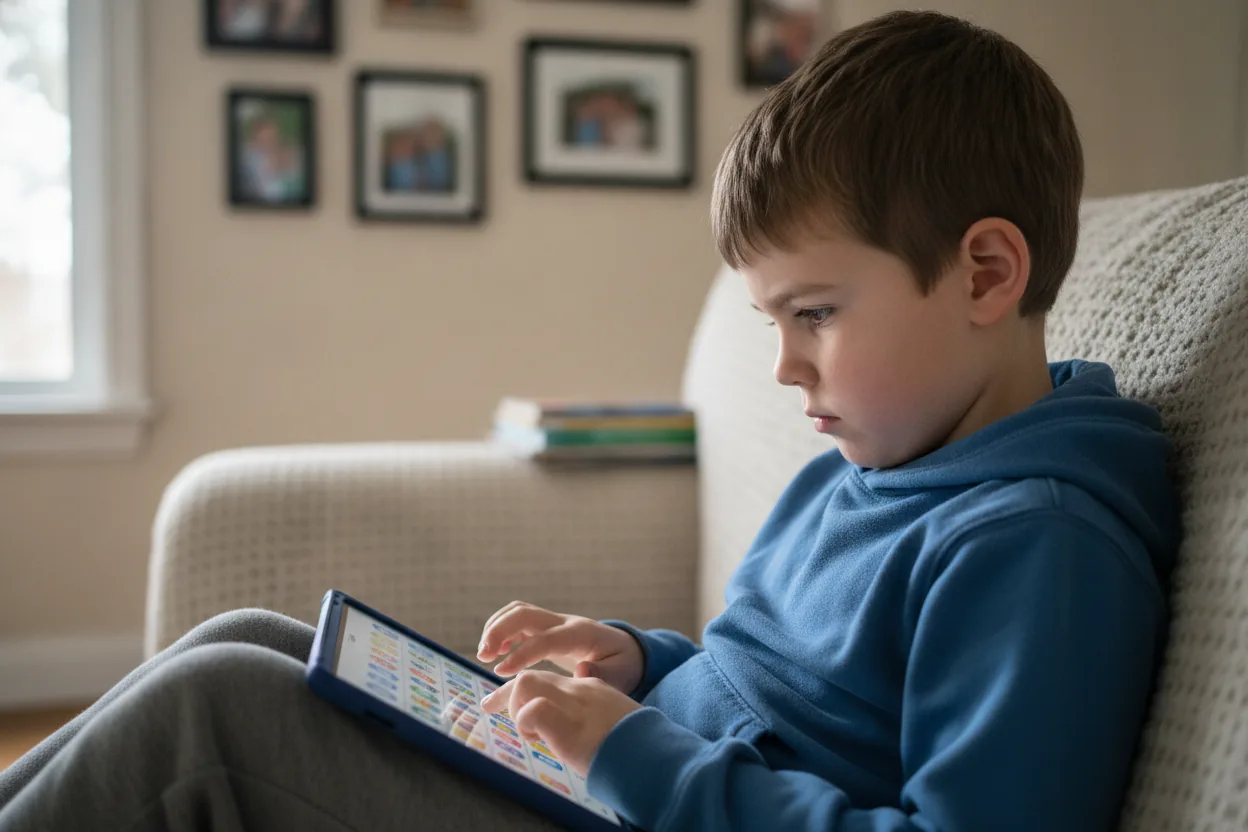
That was two years ago. Marco is seven now, autistic, and communicates through a combination of a speech-generating device, a visual schedule velcroed to his desk, and occasional spoken words that come more easily when nobody is pressuring him to produce them.
His mother, Danielle, fought for months to get his AAC device listed as accessible “across all school environments” in his IEP. The fight shouldn’t have been necessary. But it was, and versions of it are playing out in kitchens and conference rooms all over the country.
AAC Is How He Talks, Not a Consolation Prize
Here’s the thing most parents are told, sometimes directly and sometimes through implication: AAC and visual supports are bridges. Temporary workarounds. The goal, they’re told, is speech. Typical, fluid, conversational speech, produced on demand, in the expected rhythm, at the expected volume.
That belief comes from decades of speech-language pathology training that centered spoken language as the gold standard. It also comes from a culture that treats talking as the baseline for intelligence, cooperation, and social belonging. If your kid talks, they’re “progressing.” If they don’t, something still needs fixing.
But the research tells a different story. The American Speech-Language-Hearing Association’s position is clear: AAC is not a last resort and does not inhibit speech development. A 2006 review by Millar, Light, and Schlosser published in the *Journal of Speech, Language, and Hearing Research* found that AAC use either had no effect on speech production or actually increased it. More recent work supports this — Caron, Light, and McNaughton (2023) found that early, consistent AAC access was associated with gains in both symbolic expression and spoken language for young autistic children. Kids who had consistent access were more likely to develop natural speech over time, not less. Restricting AAC didn’t push kids to talk. It pushed them into silence.
And yet the myth persists. Parents hear it from well-meaning relatives. They hear it from school teams who worry that “giving” a child a device will make them lazy. They hear it from their own fear, because the world has told them that speech equals capability. When families internalize this, they sometimes limit device access at home, pulling it away during meals or play in hopes of “encouraging” verbal attempts. When schools internalize it, they create policies that confine AAC to the speech room or restrict its use to students labeled “nonverbal,” as if the right to express yourself should be rationed based on how many words a child can vocalize.
Where the Wrong Belief Came From

The idea that AAC is a crutch has roots in a broader medical model of disability — one that frames difference as deficit and intervention as correction. For decades, the dominant framework in pediatric speech therapy was to pursue spoken language above all else, with AAC introduced only after a child had “failed” to develop speech by a certain age. This created a gatekeeping problem: kids who could benefit from visual supports and AAC at age two or three didn’t get access until age five or six, losing years of communicative development.
Ido Kedar, an autistic author who types to communicate, has written about what those lost years felt like. In his book *Ido in Autismland*, he describes being trapped in a behaviorist speech program that drilled him on touching flashcards while ignoring the fact that he understood everything being said around him. “They assumed I couldn’t think because I couldn’t speak,” he writes. He didn’t get access to a letter board until he was seven. He was literate the entire time.
That model also confused output with understanding. A child who doesn’t speak in sentences may still understand complex ideas, make sophisticated choices, and have plenty to say. The bottleneck isn’t cognition. It’s motor planning, sensory processing, anxiety, or any number of neurological factors that make spoken language harder to produce on demand. When we measure expression by speech alone, we’re measuring the packaging, not the content.
The shift in how parents approach this didn’t come from top-down professional guidance. It came largely from the autistic community itself — from autistic adults who use AAC or who grew up without it and can articulate what that cost them. It came from parents in online communities sharing what actually worked: making the device available everywhere, treating it like glasses or a wheelchair rather than a reward to be earned, and refusing to apologize for their child’s way of connecting.
What Parents Are Doing at Home That Actually Works

Danielle stopped waiting for Marco to “try his words” before responding to his AAC output. That one change altered the energy between them overnight.
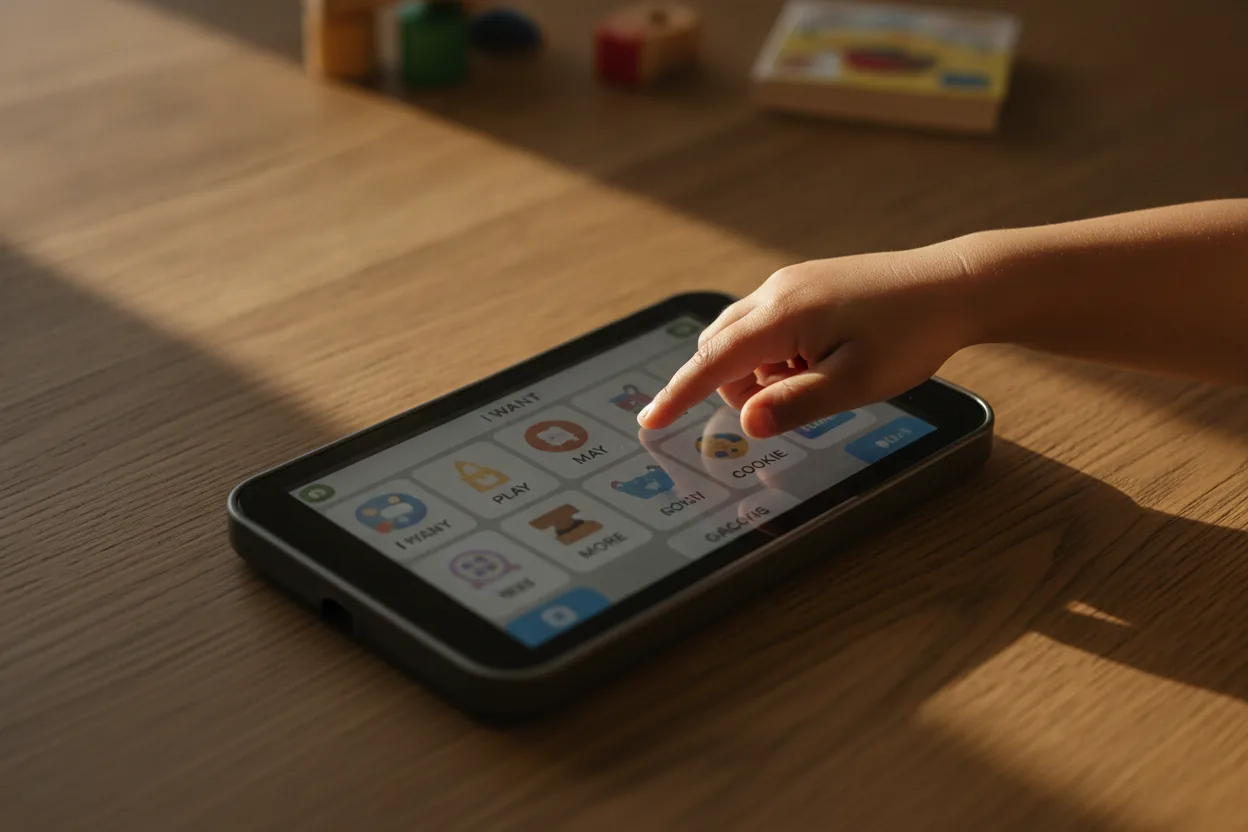
When he tapped “want crackers” on his device, she said “Crackers, great choice” and got the crackers. No follow-up prompt. No “Can you say it for me?” No withholding the crackers until he vocalized. She treated his AAC output as real language, full stop, because it was.
This approach aligns with what researchers call “aided language input” or “modeling.” A 2012 study by Binger and Light found that when partners modeled AAC use themselves — pointing to symbols on the child’s board while speaking — children’s expressive attempts increased significantly. The mechanism is straightforward: just as hearing children learn spoken language by being immersed in it, children using AAC learn to express themselves through their system when they see others use it naturally and when their own use is honored without conditions.
Parents in this space are also rethinking how they give instructions. Instead of saying, “After you finish your homework, if you’ve done a good job, maybe we can go outside for a bit,” they’re saying, “First homework. Then outside.” They’re pairing it with a visual: a first/then board with a picture of a notebook and a picture of a swing. This isn’t dumbing things down. It’s matching the instruction format to the child’s processing style. Many autistic children process visual information more efficiently than auditory information — a finding supported by research from Quill (1997) and Hodgdon (1995), who demonstrated that visual supports reduce reliance on auditory working memory and give children a stable reference point they can return to.
Another thing parents are doing: making their child’s tools available during unstructured time, not just during lessons or therapy. Mealtimes. Car rides. The grocery store. The playground. The logic is simple but often overlooked. If you only give a child access to their system during structured activities, you’re telling them that their voice only matters in certain contexts. You’re also missing the moments when they have the most to say — which, for most kids, are the unscripted ones.
The Second Mechanism No One Talks About
There’s a less obvious reason AAC and visual supports change family dynamics, and it has nothing to do with the child’s skills. It changes the parent’s behavior.
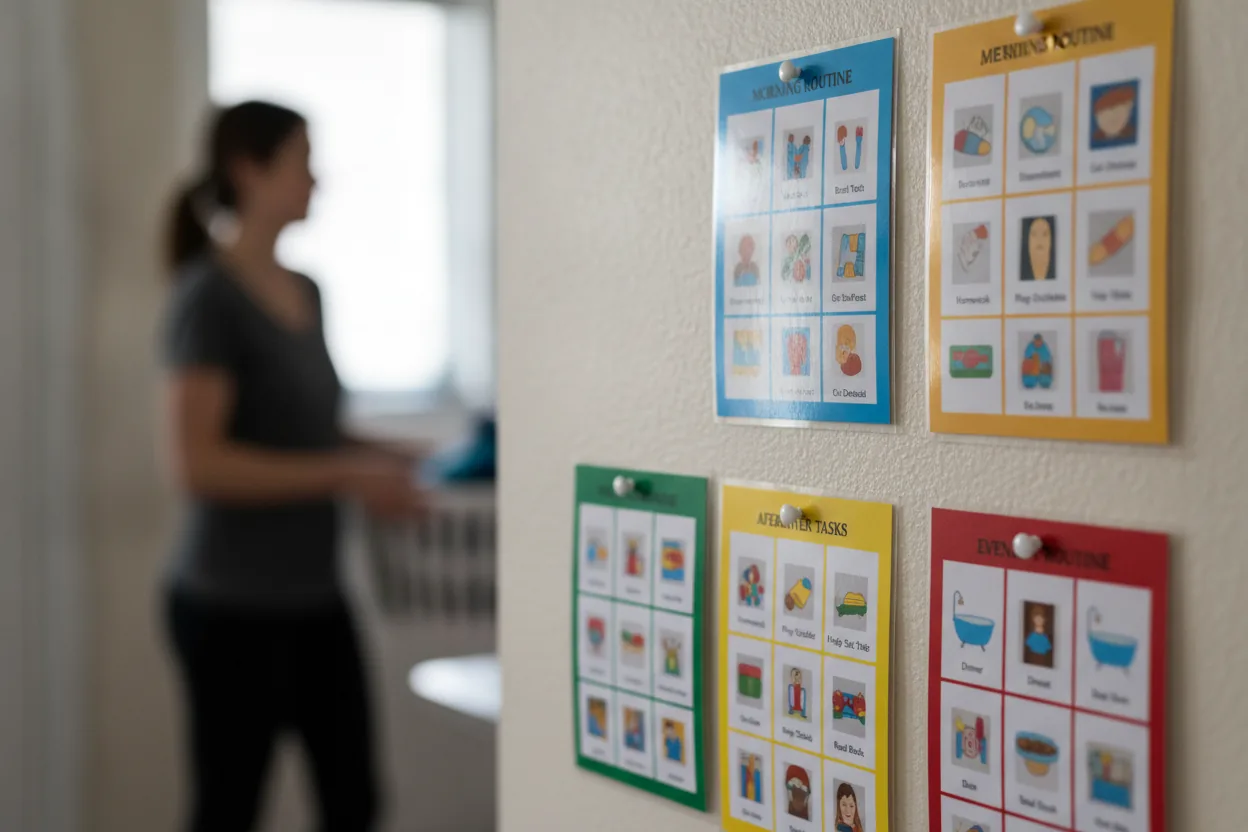
When Danielle put up a visual schedule in the kitchen, she noticed she stopped repeating herself. She stopped raising her voice during transitions. She stopped narrating every step of the morning routine in increasingly frustrated tones. The visual schedule wasn’t just supporting Marco. It was regulating her.
This is consistent with what occupational therapist and researcher Dr. Winnie Dunn has described in her work on sensory processing: environmental modifications don’t just help the child who needs them. They reduce stress across the entire household system. When parents aren’t constantly translating, repeating, prompting, and interpreting, they have more bandwidth. And when they have more bandwidth, they respond to their child’s bids for connection instead of reacting to the bids they missed.
A parallel mechanism shows up in research on Demand Avoidance Profiles and on autistic inertia. When a child’s system reduces the number of spoken demands in the environment, the child’s nervous system has less to defend against. Fewer verbal instructions means fewer moments of auditory overload, fewer processing delays that get misread as noncompliance, and fewer breakdowns that spiral into conflict. The supports aren’t just making it possible to get a point across. They’re making the environment safer. And safety is the precondition for everything else: learning, connection, flexibility, growth.
Where Schools Still Get This Wrong
The gap between what informed parents are doing at home and what many schools are providing is real, and it’s not always about bad intentions. It’s about systems that weren’t built for kids who express themselves differently.
Start with access — most families don’t have enough of it. Federal law, specifically the Individuals with Disabilities Education Act, guarantees a free appropriate public education in the least restrictive environment, and courts have consistently held that AAC access is part of that guarantee. A student who uses a speech-generating device has the right to that device in every school environment: the classroom, the cafeteria, the gym, the bus, the bathroom, the hallway. But in practice, devices get locked in desks. They stay in the speech room. They’re left behind during fire drills. One parent in a Facebook support group described picking up her daughter from school to find her AAC device in a cabinet because a substitute teacher “didn’t know how to use it.” That child spent an entire school day without a voice.
Then there’s inconsistency, which might be even more damaging. A child might have a robust visual schedule in their special education classroom but walk into general education art class with zero supports. Transition times — some of the highest-anxiety moments in a school day — often have no visual or AAC support at all. Recess, lunch, assemblies: these spaces are treated as “breaks” from support, when they’re actually the moments where the demands of connecting with others are highest and most unpredictable. Research published by Calculator and Black (2009) found that AAC use dropped significantly in inclusive settings compared to self-contained classrooms, not because students needed it less, but because the environment didn’t support it.
And then there’s framing. Some school teams still measure a child’s “progress” by how much less they use their AAC device, treating decreased use as evidence of improvement rather than as a potential sign that the child has stopped expressing themselves altogether. Others will support AAC for requesting (asking for things) but not for commenting, protesting, joking, or socializing — which limits the child to a transactional style that no neurotypical child would tolerate. When schools treat AAC as a requesting tool instead of a full system for having a say, they’re building a ceiling into the child’s day.
How to Advocate Without Burning Out
Parents shouldn’t have to fight for their child to have a voice at school. But right now, many do. Here’s what the families who’ve done it say helps.
First, get AAC access written into the IEP with specific, environment-spanning language. Not “student will use AAC device during speech sessions.” Instead: “Student will have access to their AAC system across all school environments and activities, including but not limited to classroom instruction, specials, lunch, recess, transitions, and field trips. All staff who interact with the student will receive training on the system.” The specificity matters. Vague language gives teams room to interpret, and interpretation tends to favor the status quo.
Second, request staff training as a related service. ASHA’s guidelines are clear that AAC implementation requires training for all partners — not just the speech-language pathologist. If the paraprofessional, the general education teacher, and the lunch aide don’t know how to respond to the child’s device output, the device is functionally useless in those settings. Parents can cite ASHA’s 2004 position statement on AAC when making this request.
Third, build consistency between home and school systems. If the child uses a choice board for snacks at home, send that format to school. If the school uses a specific visual schedule app, ask for access to the same one. Consistency doesn’t mean rigidity. It means the child doesn’t have to learn a new way of getting their point across every time they walk through a door.
Fourth, name the style directly. When a school team says the child is “not engaging in conversation,” a parent can say, “He communicates through his device and through direct language. Can you tell me how you’re supporting those styles in your classroom?” This reframes the conversation from what the child isn’t doing to what the environment isn’t providing.
The Shift That Changes Everything
The single biggest change parents describe isn’t a strategy or a tool. It’s a belief. It’s the moment they stop seeing their child’s way of expressing themselves as something to fix and start seeing it as something to support. Not a stepping stone. Not a phase. Not a lesser version of the “real” thing.
That shift doesn’t mean giving up on growth. Marco’s vocabulary on his device has tripled in two years. He’s started combining symbols into longer phrases. He occasionally says words aloud, usually when he’s relaxed and playing, never when he’s being tested. His ability to connect is expanding because the pressure is off, not because someone forced it forward.
For parents earlier in this process, the most useful thing to hear might be this: you don’t have to wait for permission to treat your child’s way of connecting as real. You don’t need a professional to validate that AAC counts. You don’t need to justify visual supports to anyone who suggests your child should “just listen.” You can start today by responding to every attempt your child makes to reach you — however it comes — as if it’s the most important thing they’ve ever said. Because to them, it is.
One resource worth looking at: the PrAACtical AAC website, maintained by Dr. Carole Zangari, offers free visual support templates, AAC implementation guides, and plain-language explanations of research. It’s built for parents and practitioners who want to move past the theory and into the Tuesday morning reality of making all of this actually work.
Your child’s voice doesn’t sound the way the world expected. That’s fine. The world can adjust.