


Both Things Are True: ADHD, Autism, and 3:15 PM
Her son walked through the front door, dropped his backpack on the tile, and screamed into the couch cushion for forty-five seconds straight. His teacher had just emailed to say he’d had “a great day.”
Kara (a composite of parents we’ve spoken with) stood in the kitchen holding her phone, reading the words “participated well” and “was kind to peers” while her eight-year-old sobbed so hard he couldn’t get his shoes off. This is the paradox that thousands of parents live inside when their child’s brain runs on both ADHD and autistic wiring: the kid who looks socially competent in public is running on fumes by 3:15 p.m., and nobody at school believes it because they only see the performance.
When Social Struggles Look Like Bad Manners
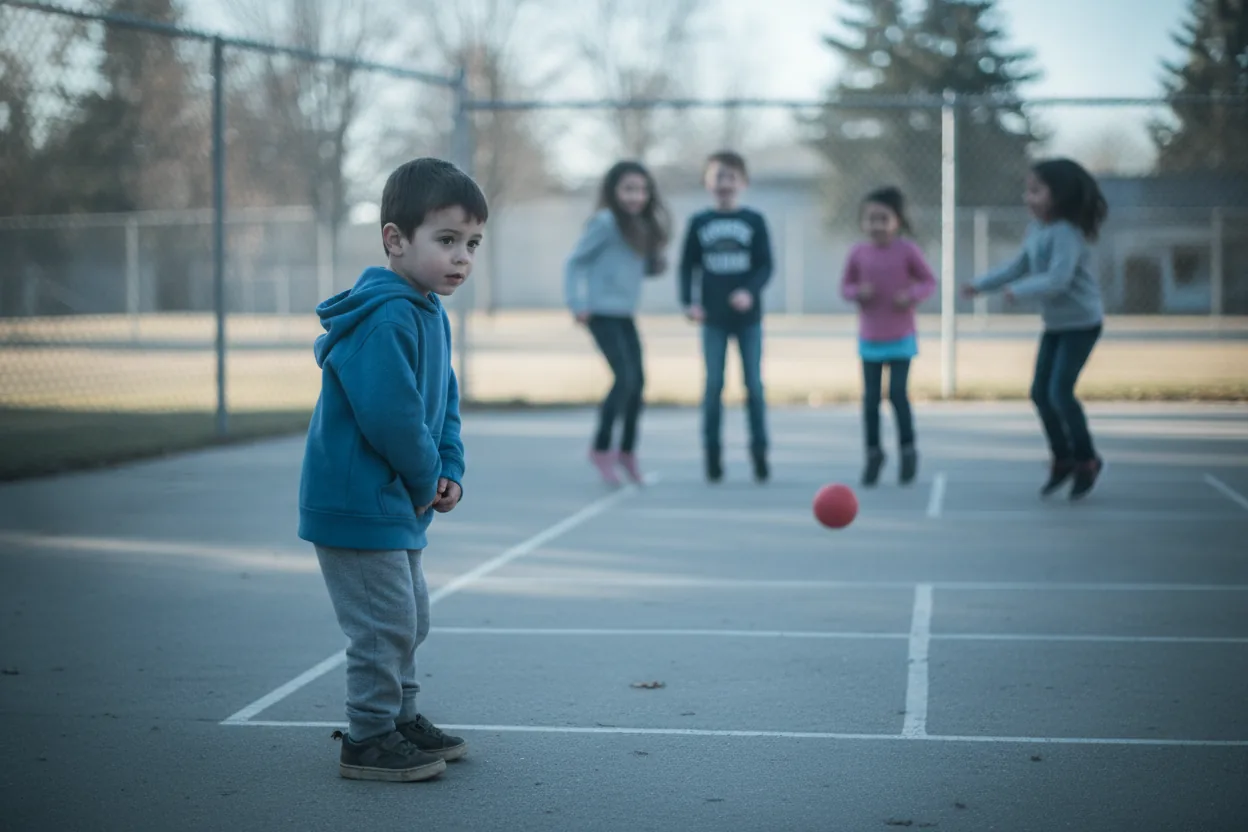
Let’s say your child interrupts a classmate mid-sentence during a group project. The teacher redirects. Later, at recess, your child stands at the edge of a four-square game, watching for six minutes, then walks away. The teacher notes “difficulty with social skills” on the progress report, and suddenly you’re fielding suggestions about social skills groups and practicing eye contact at home.
But what actually happened in those two moments may have come from completely different neurological places. The interrupting might be ADHD impulsivity — a failure of the brain’s inhibitory control system rather than a failure of caring. The hesitation at recess might be autism-related difficulty with unscripted social entry, the child genuinely unsure how to break into a game that has no visible rules for joining. And both of these things can be true in the same child, in the same hour.
Research on the ADHD-autism overlap, sometimes called AuDHD in community shorthand, shows that social difficulties in this population are frequently misattributed to a single cause when they actually reflect a layered interaction between impulsivity, sensory processing, and differences in social interpretation (Leitner, 2014; Antshel et al., 2016). A child who blurts out a comment isn’t necessarily missing the social cue that it’s not their turn. They may have read the cue perfectly and still been unable to override the impulse. Meanwhile, a child who doesn’t respond to a peer’s bid for connection may not be ignoring it. They may be processing it on a different timeline, or they may not have recognized it as a bid at all.
The distinction matters because the intervention changes completely depending on which mechanism is driving the behavior.
Masking Isn’t Just an Autism Thing

If you’ve spent any time reading about autism, you’ve probably heard the word masking — and maybe felt a sick recognition watching your kid rehearse a smile before a birthday party. Masking is well-documented in autistic populations: suppressing stimming, forcing eye contact, scripting social responses, copying the body language of popular peers. A 2019 study by Hull and colleagues found that masking in autistic individuals involved three core processes — compensation, assimilation, and concealment — all of which require significant cognitive effort.
But here’s what gets less airtime: kids with ADHD mask too. They suppress the urge to move. They swallow questions. They sit on their hands. They pretend to follow a lesson they lost track of nine minutes ago. They perform “paying attention” as a social act because they’ve learned, sometimes as early as kindergarten, that their natural way of being in a classroom is treated as disruptive.
When a child has both ADHD and autistic traits, the masking can be doubled. They’re suppressing impulsivity and regulating sensory input and performing neurotypical social behavior all at once. The internal cost of this is enormous. And the external result is a child who appears to be doing well, which makes it extraordinarily hard for parents to get support.
Kara described it this way: “His teacher keeps saying he’s fine. And I keep saying, you’re not seeing what I’m seeing. By the time he gets home, he can’t handle me asking what he wants for dinner. That’s not fine.”
She’s right. That’s not fine. That’s a child whose regulatory capacity has been spent.
The Home-School Split Is Data, Not Drama
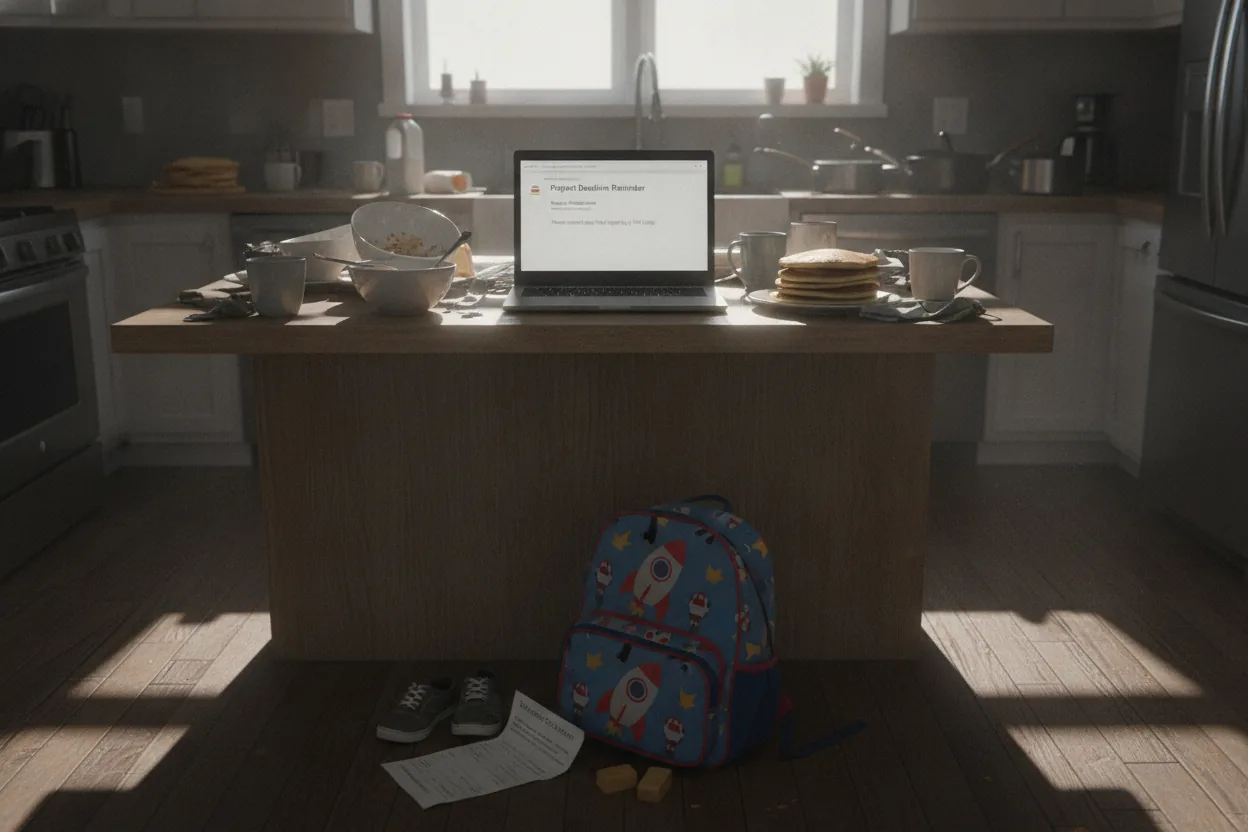
If you’re a parent who has heard some version of “he’s fine here, so maybe the issue is at home,” you already know the quiet fury of that sentence. It implies that the meltdown is something you’re causing rather than something your child has been holding off all day.
Kara learned to stop arguing and start documenting. She pulled up the teacher’s email — “Eli had a great day! Participated well in science and was kind to peers” — next to a video she’d taken twenty minutes later: Eli on the floor behind the couch, shoes still on, crying so hard he was gagging. She brought three weeks of this to the school psychologist. Not as a complaint. As data.
She said: “I’m not questioning what you’re seeing here. I’m asking you to consider what it costs him to produce it.”
The research calls this the “afterschool restraint collapse,” and it’s widely observed across ADHD and autism profiles. A child spends six or seven hours monitoring their behavior, filtering sensory input, navigating unwritten social codes, and managing the gap between their internal experience and the expected external presentation. By the time they reach the safety of home, their nervous system does what it has been needing to do for hours: it lets go.
This looks like screaming. Or crying. Or going completely silent. Or picking a fight with a sibling over nothing. Or refusing food they normally like. Or needing to be alone so badly that being spoken to feels like pain.
What’s happening in the child’s nervous system is a shift from the sympathetic overdrive of the school day — fight-or-flight mode engaged to maintain vigilance and social performance — to a parasympathetic crash. She’s not choosing this. Her nervous system is. His body isn’t doing this on purpose. Their body is doing the only thing it can do after hours of unsustainable effort.
And what’s happening in your nervous system, the parent standing in the kitchen? Your system is reading threat too. You’re watching your child in distress, you’re holding the dissonance between the teacher’s cheerful email and the reality in front of you, and your own stress response is activating. Your chest tightens. Your jaw clenches. You might feel an urge to fix it, to ask questions, to figure out what happened. All of which, in this moment, will make it worse.
The Co-Regulation Move That Costs You Nothing

Here is the single most effective thing you can do in the first twenty minutes after your child walks through the door from a high-masking day: almost nothing.
Not nothing-nothing. Intentional, warm, low-demand nothing.
You are present. You are calm, or performing calm convincingly enough that your child’s nervous system can borrow from yours. You are not asking questions. You are not processing the day. You are not offering solutions or social coaching.
You are offering a snack, a glass of water, a quiet space, and the implicit message: you don’t have to perform here.
The exact words to try: “Hey. There’s crackers on the counter. I’ll be in the kitchen if you need me.” Then you walk away. Not dismissively. Gently. You are giving their nervous system permission to stop working.
If your child needs physical proximity, sit near them without talking. If they need pressure, offer a blanket or a pillow to squeeze. If they need movement, let them bounce on a trampoline or run in the yard without narrating it. The goal is to remove demand, not to remove yourself.
Dr. Mona Delahooke, a pediatric psychologist specializing in neurodevelopmental differences, writes that the most important question to ask about a child’s behavior is not “how do I stop this?” but “what is this telling me about the child’s nervous system right now?” When you treat the after-school meltdown as information rather than a problem to solve, you change the entire dynamic.
Different Social Logic Is Still Logic
There’s a conversation happening in parent communities right now that’s worth paying attention to. Parents of kids with ADHD-autism overlap are pushing back against the idea that their children “lack” social awareness. Instead, they’re reframing it: their children have different social logic.
This isn’t just feel-good language. It changes what you look for.
A child who info-dumps about Minecraft for twelve minutes during a playdate isn’t failing to read the room. They may be offering their best version of connection: sharing something they love intensely and hoping the other person will love it too. That’s not a deficit. That’s an invitation, issued in a dialect that neurotypical peers might not recognize.
A child who corrects a friend’s factual error in front of the group isn’t being rude. They may genuinely value accuracy as a form of respect, because in their internal framework, letting someone believe something wrong would be unkind.
A child who walks away mid-conversation may have hit a sensory or processing wall and is doing the most responsible thing they can do: removing themselves before they say something hurtful or shut down entirely.
When parents and educators start asking “what is this child’s social logic?” instead of “why can’t this child follow social rules?”, the possibilities for support open up dramatically. You stop trying to patch gaps and start building bridges between two legitimate ways of communicating.
Research supports this shift. A 2012 study by Crompton and colleagues found that autistic people communicate effectively with other autistic people at rates comparable to neurotypical-to-neurotypical communication. The breakdown happens at the interface between neurotypes, not within them. This is the “double empathy problem” described by Dr. Damian Milton, and it reframes social difficulty as a bidirectional mismatch rather than a one-sided failure.
What to Do When the School Says “Fine”
Let’s go back to Kara. Her son, Eli, was diagnosed with ADHD at six and later identified with autistic traits at eight. His school had no idea about the second piece. As far as they were concerned, he was a bright kid with some attention challenges who was doing well socially.
That sentence she used with the school psychologist — “I’m not questioning what you’re seeing here, I’m asking you to consider what it costs him to produce it” — is one you can borrow. It doesn’t put the school on the defensive. It doesn’t deny their observations. It just means you’re working with more information now.
Kara requested a meeting to discuss environmental modifications that might lower Eli’s cognitive and social load during the day. Not a new IEP goal. Not structured peer coaching. Modifications designed to reduce the amount of masking he needed to do.
These included: a visual schedule on his desk so he didn’t have to hold transitions in working memory. A sensory break card he could use without asking permission. A seat near the wall instead of in the center of the room. A five-minute heads-up before unexpected changes. Permission to eat lunch in a quieter space twice a week.
None of these required a formal plan change. All of them reduced the pressure on Eli’s system. Within two weeks, the after-school meltdowns didn’t disappear, but they shortened. He started being able to answer “how was your day?” by dinnertime instead of bedtime.
Building a Low-Demand Recovery Bridge
The concept of a recovery bridge is simple, but it requires you to protect it fiercely. It’s the structured transition between the high-demand environment of school and the rest of the child’s evening.
For a child with ADHD-autism overlap, the recovery bridge might be thirty minutes. It might be ninety. It’s the period during which you consciously lower every form of demand: social, sensory, cognitive, and emotional.
One parent we talked to — she’d read every book, tried every reward chart — finally gave up asking about the school day at pickup. Instead, she let her daughter sit in the car for ten minutes after she buckled in. No music. No questions. Just sat there with her. The first few days it felt wrong, like she was ignoring her kid. By the end of the week, her daughter started talking on her own somewhere around minute seven. Not about school. About a weird bug she saw on the window. But she was talking. Her voice was calm. That was the bridge working.
This means no questions about the school day. No homework. No structured activities. No playdates. No screens if screens are dysregulating for your particular child (though for many kids, a familiar show or game is actually a regulation tool, not a cop-out). No transitions. No choices that require executive function.
What fills the bridge instead: predictable environment, available food, sensory input the child seeks (not avoids), and your quiet presence.
You can narrate the bridge without making it a big deal. Try: “We’re in chill time right now. Nothing you have to do.” Or for a younger child: “Snack is here. I’m here. That’s it.”
The bridge works because it respects what the nervous system just went through. You are not teaching your child to avoid hard things. You are giving their brain the recovery window it biologically requires after sustained effort. Adults get this when they come home from a draining meeting and sit in the car for five minutes before walking inside. Kids need it structured for them because they can’t build it themselves yet.
One Thing to Do Tomorrow
Tomorrow, when your child comes home, try this: resist the first question. Whatever it is. Don’t ask about their day, their lunch, their test, their friends. Instead, have something ready for them. A snack they like. A space that’s theirs. And say only this: “Glad you’re home.”
Then wait. Let them come to you. Let them tell you about their day in their own time, in their own way, using their own social logic. It might take ten minutes. It might take two hours. It might come as a random comment during bath time about something a kid said at recess that bothered them.
When it comes, and it will come, you’ll hear it because you didn’t chase it.
Your child isn’t broken. They aren’t rude. They aren’t clueless. They are running a different operating system in an environment built for a different one, and the effort that takes is real, even when no one at school can see it.
You can see it. That’s why you’re the one standing in the kitchen, reading the “great day” email, watching your child fall apart, and knowing both things are true.
Both things are true. And that’s where the work begins. Not the work of fixing your child, but the work of building a world around them that doesn’t require so much hiding.
—
References
Antshel, K. M., Zhang-James, Y., Wagner, K. E., Ledesma, A., & Faraone, S. V. (2016). An update on the comorbidity of ADHD and ASD: A focus on clinical management. *Expert Review of Neurotherapeutics*, 16(3), 279–293.
Crompton, C. J., Ropar, D., Evans-Williams, C. V., Flynn, E. G., & Fletcher-Watson, S. (2020). Autistic peer-to-peer information transfer is highly effective. *Autism*, 24(7), 1704–1712.
Hull, L., Petrides, K. V., Allison, C., Smith, P., Baron-Cohen, S., Lai, M.-C., & Mandy, W. (2017). “Putting on my best normal”: Social camouflaging in adults with autism spectrum conditions. *Journal of Autism and Developmental Disorders*, 47(8), 2519–2534.
Leitner, Y. (2014). The co-occurrence of autism and attention deficit hyperactivity disorder in children — what do we know? *Frontiers in Human Neuroscience*, 8, 268.
Milton, D. E. M. (2012). On the ontological status of autism: The ‘double empathy problem.’ *Disability & Society*, 27(6), 883–887.