

When the parent is also neurodivergent: stories about life
Here’s how it started for one of them.
She’s standing at her own kitchen counter, pen in hand. The form is about her son. Difficulty sustaining attention in tasks. Loses things necessary for daily activities. Often “on the go” or acts as if “driven by a motor.” She puts the pen down. Picks it up. Puts it down again. Her hand is shaking, just slightly, and she can’t tell if it’s exhaustion or recognition.
Carla, a 38-year-old project manager and mother of two in suburban Denver, remembers that night as the crack in the wall. Her son Mateo had just been referred for an ADHD evaluation. She was supposed to be gathering information about him. Instead, she was gathering evidence about herself.
“I called my best friend and said, ‘I think I have ADHD,'” Carla told me. “And she laughed. Not mean. She just said, ‘Yeah, I’ve been waiting for you to figure that out.'”
When Your Child’s ADHD Identification Mirrors Your Own

Carla’s story is not unusual. Research published in the *Journal of Attention Disorders* in 2023 found that a significant number of parents — mothers especially — first suspect their own ADHD only after their child receives a diagnosis. The study noted that this “diagnostic cascade” is particularly common among women, who were historically underidentified due to gender-biased screening criteria that emphasized hyperactive and disruptive presentations over inattentive ones. A 2022 qualitative study in *BMC Psychiatry* found that late-identified ADHD mothers frequently described their child’s assessment process as a “biographical turning point” that reframed decades of internalized inadequacy.
Carla got her own evaluation three months after Mateo’s. Combined-type ADHD. She was almost 39.
“I cried for two days,” she said. “Not sad crying. I don’t know what to call it. Like every memory I had was being re-sorted. Every report card comment, every job I got fired from in my twenties, every friendship I’d burned through. It all had a different explanation now.”
That re-sorting is what researchers call identity reconstruction. Dr. Lotta Borg Skoglund, a psychiatrist and ADHD researcher at the Karolinska Institute, has written about how late identification forces adults to revisit their entire personal narrative. The old story — “I’m lazy, I’m scattered, I’m too much” — gets replaced with a new one: “My brain works differently, and nobody told me.” Borg Skoglund’s work emphasizes that this process is rarely clean. Relief and grief arrive together, tangled up, and the emotional weight of all those years without understanding doesn’t disappear just because there’s now a name for it.
“You’re lighter,” Carla said. “But you’re also angry. Because who put the rocks in?”
Shame Didn’t Start with Parenting, But Parenting Made It Louder
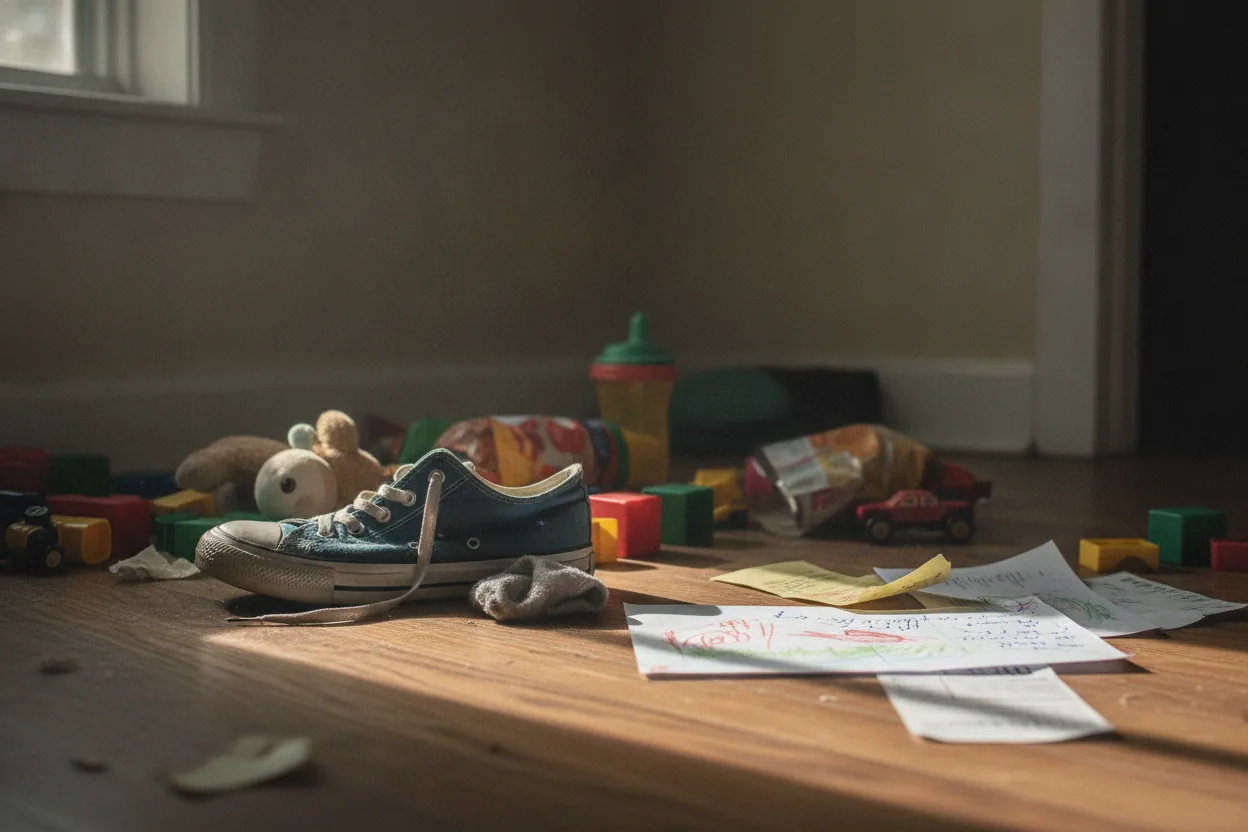
Before Mateo’s assessment, before her own, Carla had a running internal monologue she described as the “bad mom channel.” It played constantly. She forgot permission slips. She couldn’t keep the house in the state of order that other parents seemed to maintain without effort. She was always late. She yelled more than she wanted to. When Mateo struggled in first grade with focus and impulse control, she took it personally — as proof that she had somehow failed him not just as a parent but genetically.
That genetic guilt is something many late-identified ADHD parents carry. ADHD has a heritability rate of approximately 74%, according to Faraone and Larsson’s 2019 meta-analysis in *Molecular Psychiatry* (“The genetics of attention deficit hyperactivity disorder,” Vol. 24, pp. 562–575). When parents learn this, the reaction can go in two directions. Some feel a strange comfort in knowing their child’s brain makes sense within the family lineage. Others spiral into self-blame, wondering if they “gave” their child a disorder.
Carla went through both.
“My mom said, ‘Well, you were the same way, and you turned out fine,'” she recalled. “And I wanted to scream, because I didn’t turn out fine. I turned out exhausted and ashamed and medicated for anxiety that turned out to be undiagnosed ADHD. ‘Fine’ is a pretty low bar.”
Dr. Michelle Frank, a clinical psychologist specializing in ADHD across the lifespan, has described this generational pattern as one of the most emotionally loaded parts of a parent’s late evaluation. “When you realize your parent probably had it too, and their parent before them, you start to see a whole lineage of people who were struggling without language for why,” Frank wrote in a 2023 commentary for *CHADD*. “The shame gets passed down alongside the genes. Breaking that chain is some of the most important work a family can do.”
Carla is still working on that chain. Her mother refused to consider that she might also have ADHD. “She said I was looking for excuses,” Carla said. “That was a painful conversation, and we haven’t fully recovered from it.” But Carla decided that even if she couldn’t change the generation above her, she could change what got passed to the one below. That became the point — not fixing the past, but interrupting the pattern where she stood.
An Autistic Parent’s Parallel Path to Recognition

About 400 miles south of Carla, in Albuquerque, a father named James was on his own version of the same path — but with autism rather than ADHD. His daughter Wren, age nine, had been identified as autistic at six. James had spent three years learning everything he could about autism to support her. Somewhere in year two, he started to notice something uncomfortable.
“I was reading about masking,” James said. “About how autistic people, especially those who present as higher-support-needs-passing, learn to mimic social behavior. And I got this cold feeling. Like, oh. That’s me. That’s what I’ve been doing since middle school.”
James, 42, an IT manager who described himself as “the guy everyone thinks is just quiet and intense,” pursued a formal assessment. He was identified as autistic at 41. Unlike Carla, who cried, James said he felt almost nothing at first.
“It took weeks to land,” he said. “I think my brain needed to process it in its own way, on its own schedule. Which is, I guess, very autistic of me.”
James’s experience reflects a growing body of work on late-identified autistic adults. A 2024 study in *Autism in Adulthood* found that adults diagnosed after age 30 reported high rates of prior mental health misdiagnosis, with depression, anxiety, and personality disorders being the most common incorrect labels. The study also found that post-identification wellbeing improved significantly over a 12-month period, but only when the person had access to identity-affirming community and information. The name for it alone, without context, didn’t do much. It was identification plus understanding that mattered.
For James, that understanding changed how he parented Wren.
“Before my assessment, I was sympathetic to her, but I was still kind of operating from a playbook,” he said. “Like, the books say do this when she melts down, so I’ll do this. After, I stopped following the playbook and started trusting what I already knew from the inside. When Wren is overwhelmed, I know what overwhelm feels like. I don’t need a chart for that.”
How Neurodivergent Lineage Changes the Air in a Home
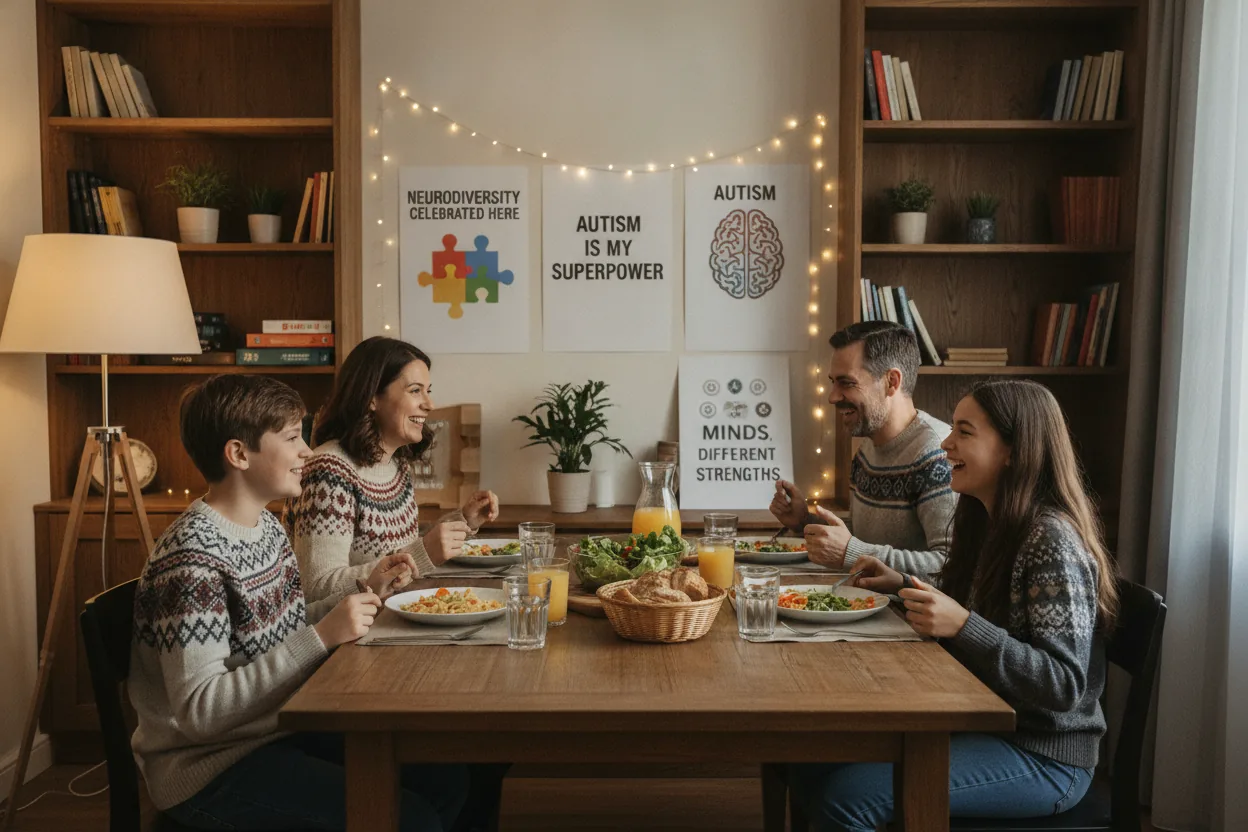
There’s a phrase gaining traction among parents in neurodivergent communities: neurodivergent lineage. It’s not a clinical term. You won’t find it in the DSM-5. But it describes something real and specific — the recognition that ADHD, autism, dyslexia, and sensory processing differences tend to cluster in families, and that naming this pattern out loud can fundamentally change how a household operates.
When Carla told Mateo that she also had ADHD, his first response was, “So we’re the same kind of brain?” She said yes. He smiled and went back to his Legos. It was, she said, the easiest and most important conversation she’d ever had with him.
“He didn’t feel like the broken one anymore,” she said. “Because it wasn’t just him. It was us. It was a family thing.”
James had a similar experience. When he told Wren that he was autistic too, she asked him if it meant they could stim together. They now have what they call “flap time” after dinner — a few minutes where they let their bodies do what their bodies want to do without filtering. James said his wife, who is not autistic, initially found it odd and then found it beautiful.
“She said, ‘You two are more yourselves during flap time than any other part of the day.’ And she was right.”
This mutual normalization — where traits are treated as family patterns rather than individual deficits — shows up consistently in research on neurodivergent families. A 2023 study in *The Journal of Child and Family Studies* found that when parents openly identified as neurodivergent alongside their children, those children reported lower levels of internalized stigma and higher self-esteem related to their identification. The mechanism isn’t complicated. Kids look to their parents to understand whether something about them is a problem or just a fact. When a parent says, “My brain does that too, and it’s okay,” they’re not just reassuring. They’re modeling a relationship with neurodivergence that’s grounded in acceptance rather than correction.
The Specific Shift: From “What’s Wrong with Them” to “What Do We Need”
Both Carla and James described a concrete change in how they ran their homes after their own assessments. It wasn’t about learning new parenting techniques, though some of that happened too. It was about changing the question.
Before her evaluation, Carla’s default response to friction was, “Why can’t he just…” Why can’t he just sit still. Why can’t he just remember his homework. Why can’t he just stop arguing. After, the question shifted to, “What does this situation need?” Sometimes the answer was a body break. Sometimes it was fewer words. Sometimes it was acknowledging that she, too, was dysregulated and needed to step out of the room for 90 seconds before she could respond with any clarity.
“I stopped expecting him to perform neurotypicality,” Carla said. “Because I finally admitted to myself that I couldn’t either.”
James described his shift differently. For him, it was about permission. Before his identification, he had a rigid internal standard for what a “good father” looked like: present, patient, emotionally available in the specific ways that parenting books described. After, he gave himself permission to be emotionally available in his own way. He might not make eye contact during a hard conversation with Wren, but he’d sit next to her and let their shoulders touch, and she’d talk more openly than she ever did face to face.
“I stopped trying to parent like a neurotypical dad and started parenting like her dad,” he said. “Turns out those are different things.”
Dr. Devon MacEachron, a psychologist who works extensively with gifted and neurodivergent families, has written about how parental self-understanding directly affects a child’s sense of safety. “When a parent is fighting their own neurology, the child picks up on that tension,” MacEachron noted in a 2022 interview. “They sense that difference is dangerous, something to be hidden or overcome. When a parent accepts their own wiring, the child gets a different message entirely: you can be yourself here.”
What It Costs and What It’s Worth
It would be dishonest to present late identification as uncomplicated good news. Both Carla and James described real costs.
For Carla, the hardest part was her relationship with her own mother. Once she understood the generational pattern, she couldn’t un-see it. Her mother’s forgetfulness, her explosive temper, her lifelong difficulty maintaining friendships. Carla believed her mother also had undiagnosed ADHD, but her mother refused to consider it.
For James, the cost was grief. Not grief about Wren. Grief about the three decades he spent forcing himself into social situations that drained him, performing normalcy at a cost he could now quantify. “I lost a lot of years to masking,” he said. “I can’t get those back. I can only make sure Wren doesn’t lose hers.”
There are also practical costs. Adult ADHD and autism evaluations are expensive — parents commonly report paying $1,500 to $3,000 out of pocket, a range consistent with data from CHADD’s resource guides and ADDitude’s 2023 reader surveys, though costs vary significantly by region and provider. Many insurance plans don’t cover them. Wait times for adult assessments in the U.S. currently average three to twelve months depending on location and provider availability. For parents already stretched thin by their child’s needs, pursuing their own evaluation can feel like a luxury they can’t afford in time, money, or emotional bandwidth.
But both Carla and James said it was worth it. Carla still loses her keys. James still finds parties unbearable. Mateo still struggles with transitions, and Wren still needs noise-canceling headphones in the school cafeteria. Having the name for it didn’t make the hard things disappear. It made them stop being evidence of failure.
“I used to think we were a family that couldn’t get it together,” Carla said. “Now I think we’re a family that runs on a different operating system. We still crash sometimes. But at least we know why.”
What You Can Try Tonight
If you’re reading this and seeing yourself in Carla or James, here are some starting points that don’t require a formal evaluation to begin.
Name the pattern out loud — the way Carla did with Mateo. You can say to your child, “I notice I have a hard time with transitions too. It’s how our brains are wired. Let’s figure out what helps both of us.” Carla started using this kind of shared language at dinner, and she said Mateo began offering his own observations back: “Mom, I think we both need a break before homework.” That one sentence from a seven-year-old told her the approach was working. The child stopped being the only one with the problem.
Replace “Why can’t you just…” with “What do you need right now?” This is not a therapeutic reframe. It’s a genuine question. Sometimes your child doesn’t know the answer. That’s fine. The question itself signals that you’re on their side and that you believe their struggle has a reason beyond willfulness. James uses a variation with Wren: “Is this a ‘help me’ or a ‘leave me’ moment?” She picks one, and he follows her lead. He said it took about two weeks for her to start answering honestly instead of defaulting to “I’m fine.”
Build a “same brain” micro-ritual. James and Wren’s post-dinner flap time takes three to five minutes. Carla and Mateo do something different: they use the *Finch* self-care app together before bed, each checking in on their own “energy bird” and comparing notes. (“His bird is always more tired than mine,” Carla said, “which honestly tracks.”) The format matters less than the signal — that shared neurology is a connection point, not a deficit. If your household runs on timers, set one. If your kid prefers physical activity, knead bread dough together or do wall push-ups side by side. Make it specific, make it short, and give it a name so anyone can call for it.
Adopt a family phrase for “I’m at my limit.” Carla’s family uses “brain’s full.” James and Wren say “battery low.” The phrase has to be shame-free and available to everyone — adults included. When Carla says “brain’s full” to Mateo, she’s modeling that hitting a limit is information, not failure. She said the first time she used it in front of him, he looked visibly relieved and said, “Oh good, me too.”
Say what you’re noticing to someone safe. If you suspect you might have ADHD or be autistic, you don’t have to pursue evaluation immediately. But stop holding it alone. Carla’s first step was that late-night call to her best friend. James told his wife over a weekend morning when the kids were out. Both said that hearing themselves say it out loud was what made it real enough to act on.
And if you’re past the suspicion stage and into the grief-and-relief stage, know this: what you’re feeling is documented. It’s common. A 2023 survey by ADHD UK found that 73% of late-identified adults reported a complicated emotional response, with “relief” and “grief” being the two most frequently cited feelings. You are not overreacting. You are catching up.
The families that seem to do best with this — according to the research and according to Carla and James and dozens of parents like them — are not the ones who get everything right. They’re the ones who stop pretending the hard parts aren’t there. They let the evaluation be information. They let the lineage be connection. They let the kid see that the parent is also figuring it out, and that figuring it out is not the same thing as failing.
Mateo asked Carla recently if ADHD would go away when he grew up. She told him the truth. “No. But you’ll understand it better. And you won’t have to do it alone, because I’ll be right here with the same brain, trying to remember where I put my car keys.”
He laughed. She did too.
That’s not a cure. It’s something better. It’s a family that finally makes sense to itself.