


Regulation Was Never the Goal — Conditions Were
You already know the line. You’ve read it in parenting books, heard it from therapists, seen it on Instagram reels with soft piano music playing underneath. “Kids can only regulate when the adult in the room is regulated first.” You nod because it makes sense. And then you spend the rest of the day trying to perform a version of calm you’ve never once felt naturally, and by 4 p.m. you’re so overloaded that you snap over spilled water.
If you’re an ADHD or autistic parent raising a neurodivergent kid, the “be the calm adult” instruction isn’t just hard. It’s a setup. It asks you to do the exact thing your own neurology makes inconsistent, and then frames every lapse as the reason your child is struggling. That’s not a parenting strategy. That’s a guilt machine. To be clear: the science of co-regulation is real. Kids’ nervous systems genuinely do borrow from adult nervous systems. But the way that research gets translated into “just be calm” advice ignores neurodivergent neurology entirely, and the gap between the science and the implementation is where parents like you get crushed.
Here’s what nobody said clearly enough until recently: neurodivergent parent regulation isn’t about constant self-control. You do not have to be perfectly steady to parent well. Not even most of the time. The research and the lived experience are converging on something more honest and more useful. Staying regulated as a neurodivergent parent means changing the conditions that make keeping your footing possible in the first place, and knowing what to do when it falls apart anyway.
Why “Perform Calm” Fails ADHD and Autistic Parents

Let’s name what’s actually happening when an ADHD or autistic parent tries to hold it together all day.
ADHD brains have variable access to executive function, which includes managing your emotional state. It’s not a skill deficit in the traditional sense. It’s a dopamine availability problem. Some moments you have full access. Other moments, especially under stress, sleep deprivation, or sensory overload, the system goes offline. You can’t willpower your way into a neurochemical state you don’t have the raw materials for.
Autistic parents face a different but overlapping challenge. Sensory input accumulates. Social masking draws from a finite well. The demand to read a child’s cues, manage a household, navigate transitions, and suppress your own sensory distress simultaneously doesn’t just feel hard. It actually depletes the nervous system in a measurable way. If you’ve hit a wall where you can’t do things you used to do without thinking — making a phone call, answering a question, tolerating the sound of chewing — that’s not laziness. Researchers have a name for it: autistic burnout, a state of chronic exhaustion, reduced functioning, and increased sensitivity that comes from sustained effort to meet environmental demands without adequate support (Raymaker et al., 2020).
Now layer on the parenting advice that says you should be the steady one. Always. Because your child needs it.
What you get isn’t a calmer parent. What you get is a parent who masks harder, crashes harder, and then feels like a failure for being human. The “perfectly regulated adult” ideal, when applied to neurodivergent parents, functions less like guidance and more like a standard built for a nervous system you don’t have.
A Better Framework for Neurodivergent Parent Regulation
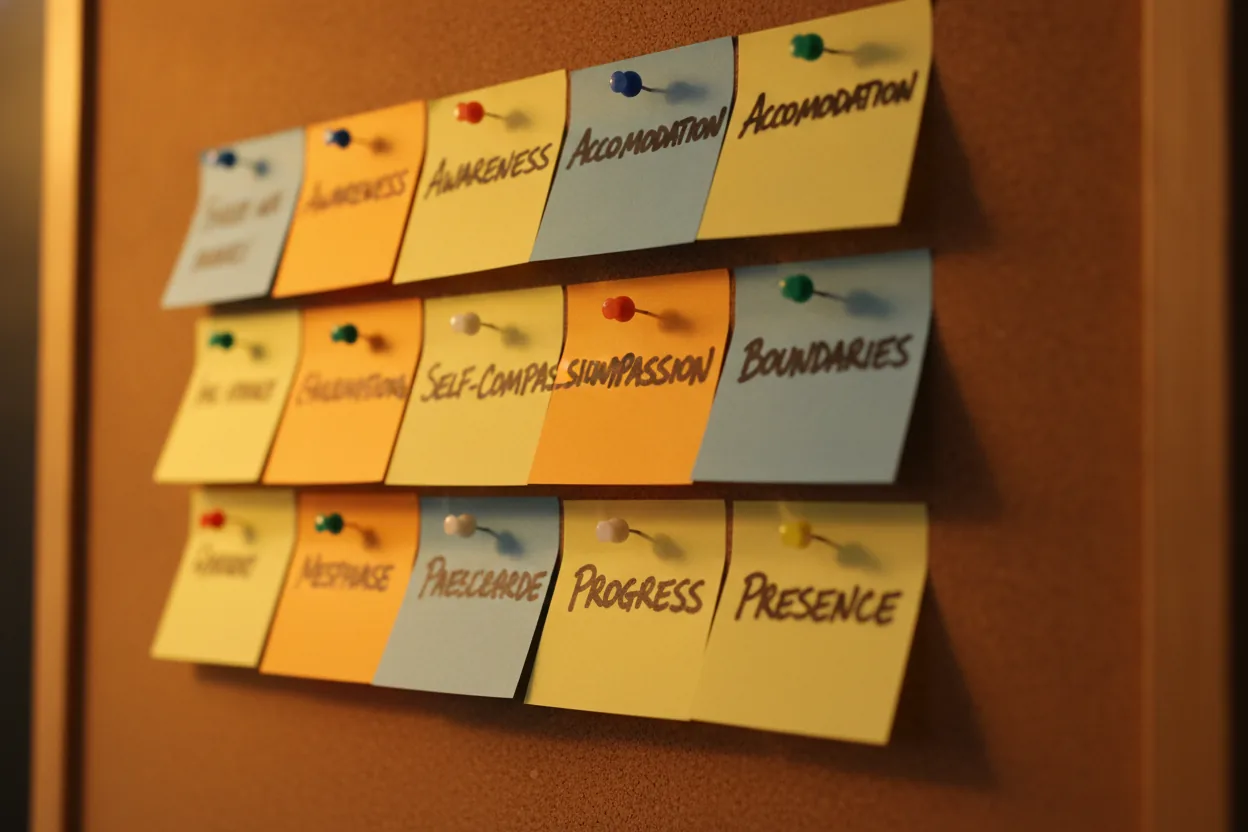
So what actually works?
A practical framework that keeps showing up in both clinical discussions and parent communities centers on four things: awareness, accommodation, repair, and support. This isn’t a branded program. It’s an editorial synthesis we’ve built from overlapping sources — elements of it appear in Mona Delahooke’s clinical work on nervous-system-first approaches, in the Maslach burnout research on reducing demands versus adding coping skills, and in ADHD and autistic parent communities where people have been problem-solving this in real time for years. It’s a description of what neurodivergent parents who are staying afloat tend to actually do, whether or not they have language for it.
Awareness means noticing your state without judging it. Not “I should be calmer right now” but “I’m at a 7 out of 10 and climbing.” That’s it. You don’t have to fix it in the moment. You just have to know where you are. For ADHD parents, this might sound like an internal check-in: “Am I reacting to what’s happening, or to the fact that I’m already overwhelmed from the last three things?” For autistic parents, it might be recognizing the early signs of sensory overload before it becomes a shutdown: the sound sensitivity ticking up, the growing need to stop talking, the urge to leave the room.
Accommodation means changing the environment or the demands rather than forcing yourself to manage harder. This is the piece most traditional parenting advice skips entirely. You’re told to stay steady, but nobody asks whether the conditions you’re parenting in actually allow steadiness. If your kitchen is loud, bright, and chaotic at 5 p.m. while you’re making dinner and fielding questions from two kids and a dog, the answer isn’t “breathe deeper.” The answer might be noise-reducing earbuds, a simpler meal plan, or asking the kids to have screen time for twenty minutes so you can cook without narrating every step.
This is where it gets personal. A parent I’ll call Danielle — whose house at 5 p.m. sounds like a blender running inside a bounce house, her son stimming loudly on the couch while the dog loses its mind at nothing — described her turning point not as learning a new calm-down technique but as giving herself permission to wear Loop earplugs in her own house. “I could still hear him,” she said. “I could still respond. But the edge came off every sound, and suddenly I wasn’t starting at a 6 out of 10 before anything even happened.” She also moved the after-school routine outside. Her son needed sensory input when he got home. She needed air and space. The backyard solved both problems at once, and it didn’t require her to be in a state of zen. It just required fewer walls and less fluorescent light.
That’s accommodation for the parent, not just the child. And it matters enormously.
Repair is covered below — it’s big enough to need its own section.
Support is covered after that — because it’s the piece most likely to get skipped, and it’s the one you can’t skip.
Lower the Load Before You Try to Stay Steady

There’s an order of operations here that most advice gets backwards. The conventional sequence goes: feel overwhelmed, try to regulate, then parent. The sustainable sequence goes: reduce the load, let keeping your footing become more possible, then parent from whatever state you’re actually in.
This isn’t just a feel-good reframe. Burnout research consistently shows that the ability to manage your emotional state improves when demands decrease — not when coping strategies increase. The Maslach burnout framework identifies chronic overload itself as the primary driver, meaning skills training without load reduction is treating the symptom while feeding the cause (Maslach & Leiter, 2016). The Raymaker autistic burnout study found the same pattern in autistic adults specifically: when environmental demands exceeded support, functioning collapsed regardless of coping ability (Raymaker et al., 2020). For neurodivergent parents, a small intervention study with parents of children with ASD and ADHD found that burnout scores dropped substantially after a 2.5-month counseling program that included both emotional management strategies and practical load reduction, with parents reporting improved parent-child relationships alongside decreased exhaustion (Gérain et al., 2022).
What does lowering the load actually look like on a Tuesday?
It looks like meal prepping on Sunday so you’re not making decisions at 5 p.m. when your executive function is gone. It looks like saying no to the birthday party that would require 90 minutes of social performance from both you and your child. It looks like having a “low demand” protocol for bad days: screens are fine, cereal for dinner is fine, nobody has to shower, and the only goal is staying connected enough that everyone feels safe.
A dad I’ll call Marcus — whose eight-year-old walks in the door after school already vibrating, shoes off mid-hallway, backpack launched, talking at full volume about something that happened at recess while simultaneously needing a snack five seconds ago — described his version of this. “I used to try to run the full routine every single day. Homework, dinner, bath, reading, bed. And by Wednesday I was done. Just toast.” His shift was building a two-tier system. Tier one was the full routine for good-capacity days. Tier two was the survival routine: easy food, no homework battles, audiobook instead of reading aloud, and bedtime whenever everyone was tired. “The first time I used tier two, I felt guilty for about an hour. Then I realized both kids were calmer, I was calmer, and nobody had yelled. That was better than any perfect routine I’d ever white-knuckled through.”
Repair Is the Strategy, Not the Backup Plan

Here’s where the framework gets genuinely freeing. Repair isn’t what you do when you fail at staying steady. Repair is the strategy.
Developmental research has been saying this for decades, even if it hasn’t filtered into mainstream parenting culture cleanly. Ed Tronick’s “still face” experiments showed that parent-child interactions naturally cycle through attunement, misattunement, and repair. The repair is what builds security, not the perfection (Tronick, 2007). Healthy attachment doesn’t require a parent who never loses it. It requires a parent who comes back.
For ADHD parents, this is critical, because emotional impulsivity is a core feature of ADHD, not a personal failing. You might snap. You might raise your voice. You might walk out of the room mid-sentence because you hit a wall. None of those moments define your parenting. What defines it is what happens next.
Repair can sound like: “I got really frustrated back there, and I raised my voice. That wasn’t about you. My brain was overloaded and I didn’t handle it well. I’m sorry, and I’m here now.”
For autistic parents, repair might also mean naming what happened in your body: “I needed to leave the room because the noise was too much for my brain. It wasn’t because I didn’t want to be with you. I needed quiet so I could come back and be with you better.”
Kids, especially neurodivergent kids, learn more from watching repair modeled than from watching perfection performed. When you narrate what happened in your nervous system and then reconnect, you’re teaching your child that dysregulation is survivable, that relationships can bend without breaking, and that naming your experience honestly is a form of strength. That’s not a consolation prize. That’s the actual lesson.
What Co-Regulation Looks Like When Both Brains Are Wired Differently
Co-regulation gets talked about like it’s one person being calm and the other person borrowing that calm. That model works sometimes. It also assumes one person in the dyad has a surplus of steadiness to share.
When you’re an ADHD parent with an autistic child, or an autistic parent with an ADHD child, or any combination of neurotypes that means both of you are running on variable systems, co-regulation has to look different.
Sometimes co-regulation is parallel. You’re in the same room, both doing your own thing, both calming down separately but together. Your child is under a weighted blanket. You’re sitting on the floor with noise-canceling headphones on. Nobody is talking. Nobody needs to. The co-regulation is in the shared space and the absence of pressure.
Sometimes co-regulation is sequential. You can’t keep your footing right now, so you tag out. You say, “I need five minutes. I’ll be in the bedroom. I’m coming back.” And then you actually come back. The steadiness happens in the return, not in the leaving.
Sometimes co-regulation is just honesty. “I’m having a hard time too. We’re both having a hard time. Let’s be having a hard time together.” That sentence, spoken without performance, can bring a child’s nervous system down more than any forced calm voice ever could. Because what kids actually need isn’t a perfectly regulated parent. They need a parent who is honest, present enough, and coming back.
External Support Isn’t Optional, It’s Structural
One more piece of this framework, and it’s the one most likely to get skipped: support.
Neurodivergent parents burning out in isolation isn’t a personal failing. It’s a structural problem. Research on parental burnout highlights social support and coping resources as significant protective factors against chronic parenting stress (Mikolajczak et al., 2018). This is true for all parents, but it’s amplified for ADHD and autistic parents who may have smaller social networks, higher masking demands in social settings, and less access to family support that actually understands their neurology.
Support might mean therapy with someone who understands ADHD or autism in adults, not just in children. The counseling intervention study mentioned earlier found that even a relatively brief structured program reduced burnout scores and improved the ability to manage your state in parents of neurodivergent kids (Gérain et al., 2022). It might mean an online community where you don’t have to explain why you wore earplugs at your kid’s soccer game. It might mean a co-parent agreement that names specific signals for “I need to tag out right now” with no guilt attached. It might mean hiring help for the thing you keep failing at, whether that’s cooking, cleaning, or the morning routine, not because you’re lazy but because your executive function has a hard cap and you’ve been exceeding it daily.
Danielle, the parent with the Loop earplugs, eventually also started seeing a therapist who specialized in late-diagnosed ADHD in women. She told me: “‘You’re not dysregulated because you’re a bad parent. You’re dysregulated because you’re running a system that was never designed with your brain in mind.’ That one sentence changed more than any breathing exercise ever did.”
The Reassurance Under All of This
Here’s the thing underneath everything you just read.
You were never failing. You were trying to meet a standard that wasn’t built for your neurology, with tools that assumed a nervous system you don’t have, in conditions that nobody adjusted for you. Of course you were burning out. Of course you were snapping at 4 p.m. Of course the “be the calm parent” advice felt like being told to run a marathon on a broken ankle and smile while doing it.
The better question was never “how do I stay calm?” It was “what would need to change so that calm becomes more possible, more often, without costing me everything?”
That question has answers. Real ones. Earbuds and easier dinners and tier-two routines and tagging out and coming back and saying “I’m sorry, I’m here now” and getting a therapist who actually gets it and stopping, fully stopping, the performance of a steadiness you were never going to sustain.
Your kids don’t need you to be perfectly regulated. They need you to be honest, present enough, and willing to repair. They need a parent who builds a life where keeping your footing is possible instead of one who white-knuckles through every day pretending it already is.
That’s not settling. That’s the strategy.